Date
Paris
CountryFrance
- Reading
- 16 min
- Words
- 3,696
- Images
- 26
Part 5: Scenes of Paris
After leaving the Louvre, I took the Metro across the city. The train was crowded and loud, and I stood holding onto a pole as we rattled through the tunnels. I was tired from walking all day, but I wasn’t ready to stop yet. I still had a few hours of daylight left, and I wanted to see as much of Paris as I could before it got dark.
I got off near Montmartre and started making my way up into the hilly streets of the 18th arrondissement. This part of Paris felt completely different from the grand, formal area around the Louvre. It was rawer, louder, and more alive. As I walked, I passed through the edges of the Red Light District, where neon signs were already flickering on and adult theaters were opening for the evening.
I was 22 years old, single, and very curious. At that age, I wasn’t the type to just walk past something like that without at least taking a look. So instead of continuing straight toward Sacré-Cœur, I turned and went inside one of the theaters.

The Jewel of Paris
The Eiffel Tower stands illuminated against the night sky, its intricate iron lattice glowing brightly. Built in 1889 for the World’s Fair, it was the tallest man-made structure in the world at the time. In the foreground, the fountains of the Trocadéro are lit up and spraying water in synchronized patterns. The contrast between the brilliant lights and the dark sky creates one of the most iconic and enduring nighttime views of Paris.
My Photographs from today
Scenes of Paris
-

Pont Neuf at Dusk Get this as a printAfter getting off the Metro, I started walking through the streets toward Montmartre. The light was fading, and Paris was shifting into its evening mood. I crossed the Seine on the Pont Neuf — the oldest bridge still standing in the city. At the time, I had no idea it dated back to the late 1500s and was considered revolutionary when it was built because it was the first bridge in Paris without houses on it, and the first to have actual sidewalks for pedestrians.
I stopped for a moment and took this photograph. The stone arches reflected beautifully in the still water below. It was quiet and peaceful — a calm moment before I continued into the more colorful and chaotic parts of the city that were waiting just ahead.
-

The Moulin Rouge Get this as a printAfter crossing the Pont Neuf, I kept walking and suddenly found myself standing right in front of the famous Moulin Rouge. I hadn’t planned to be here — it was completely unexpected. The iconic red windmill on top of the building was lit up against the night sky.
The Moulin Rouge (the Red Windmill) first opened in 1889, the same year the Eiffel Tower was built. It quickly became one of the most famous cabarets in the world, known for its wild nightlife, the can-can dancers, and as a gathering place for artists, writers, and the bohemian crowd of Montmartre.
In 1994, the area around it was still a classic, gritty Red Light District. The streets were lined with sex shops, peep shows, strip clubs, and adult theaters, all glowing with bright neon signs. It had a charged, slightly dangerous energy that felt exciting and a little overwhelming at the same time — especially for a 22-year-old kid from Nebraska walking through it alone at night.
Since I was already there, I decided to check out the neighborhood and see what else this part of Paris had to offer.
-
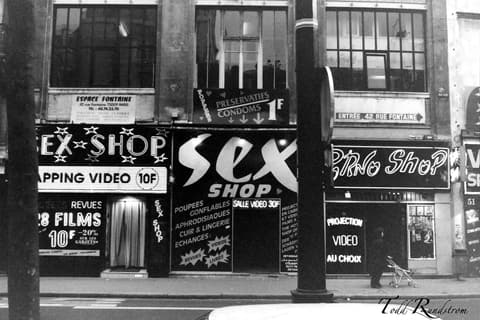
Not in Kearney Anymore Get this as a printI turned a corner and suddenly found myself standing right in front of this. Big, bold signs for sex shops, video booths, and adult theaters were everywhere — loud, neon, and completely unapologetic.
Back home in Kearney, anything like this would’ve been completely forbidden. No one in conservative rural Nebraska would tolerate this. However, here I found the complete opposite. Everything was out in the open, bigger, brighter, and right in your face. I stood there for a minute, just staring. My heart was beating faster. I was shocked, surprised… and yeah, my juices were definitely flowing.
This was definitely not home.
-

Club Privé – Live Show Get this as a printA little further down the street, I came across this place — “Club Privé Live Show Theatre.” The entrance was open, and I could see rows of small oval photographs displayed just inside the doorway. They were pictures of the women who worked there.
I stood on the sidewalk for a minute, watching a few men go inside. The crosswalk signal right in front of the entrance showed the little white walking man, as if it were literally telling people to come on in. I felt that pull. I was 22, far from home, and this whole world was new to me.
I took the photo… and then I made a decision.
-

Artists on the Street Get this as a printAfter I came back outside, I kept walking and soon found myself among more street artists. They were set up along the sidewalk with their paintings and prints, working right there in the open air. It felt familiar and grounding after what I had just experienced.
I stood there for a while, watching them paint and talk with people. I was still buzzing from everything that had happened in the last hour. I took a few photos of the artists and kept moving, heading toward Sacré-Cœur.
I was loving every minute of this day!
-

Caricature Row Get this as a printA little further along, I came across a whole row of caricature artists set up under umbrellas. One artist was working on a portrait of a woman sitting in front of him, while others sketched nearby. People were gathered around watching, some waiting their turn, others just enjoying the show.
It was lively and fun — a completely different energy from the more serious painters I had seen earlier. I stood there for a while, watching the artists work and listening to the laughter. This part of Montmartre felt alive in the best way.
-

First Glimpse of Sacré-Cœur Get this as a printAfter walking through the streets of Montmartre, I finally caught my first real view of the Sacré-Cœur Basilica rising above the rooftops in the distance. Its white domes stood out clearly against the sky.
The area around it was lively — people moving up and down the cobblestone streets, cafés with outdoor seating, and the general energy of Montmartre in full swing. I stood there for a moment, just looking up at it. After everything that had happened earlier in the evening, seeing this famous landmark felt like a small, grounding moment.
I kept walking toward it.
-

Street Sketchers Get this as a printA little further along, I came across two older sketch artists working on portraits of two friends. What was fascinating is that each of the artists was drawing a different friend.
Sacré-Cœur rose in the background, its white domes visible above the rooftops. The whole scene felt very Montmartre — artists working in the open, cafés buzzing, and the energy of the hill alive with people.
-

Evening on the Steps Get this as a printI finally reached the base of Sacré-Cœur. The wide stone steps were filled with people sitting, relaxing, and enjoying the view of Paris spread out below. Some were talking quietly, others were just sitting in silence, taking it all in as the light faded.
Sacré-Cœur means “Sacred Heart” — referring to the Sacred Heart of Jesus. It was built as an act of national penance after the Franco-Prussian War and the bloody Paris Commune uprising of 1871. Many French Catholics at the time believed the defeat and violence were divine punishment, and this basilica was meant to be a symbol of repentance, hope, and spiritual renewal for the nation. Construction began in 1875 on the highest point in Paris, and it wasn’t completed until 1914.
I stood there for a while, looking out over the city, then climbed the steps and found a place to sit down myself. After everything that I had experienced today, it felt good to just sit quietly for a bit.
-

View from the Steps Get this as a printFrom higher up on the steps of Sacré-Cœur, I looked down over the lively square below. The carousel was turning slowly, and people were scattered across the open space — some sitting on benches, others walking through or gathering near the cafés. The rooftops of Montmartre stretched out in every direction.
It was a beautiful vantage point. I could see the energy of the neighborhood from above — the mix of tourists, locals, artists, and street vendors all sharing the same space.
-

Rooftops of Paris Get this as a printFrom higher up on the steps of Sacré-Cœur, I looked out over the endless rooftops of Paris stretching into the distance. The grey zinc roofs, chimneys, and tightly packed buildings created a beautiful, textured landscape that felt uniquely Parisian.
-

Postcard Vendor Get this as a printOn the terrace in front of Sacré-Cœur, I came across this postcard vendor. He was holding up a long strip of postcards, offering them to tourists for 10 francs each. Behind him, the rooftops of Paris stretched out in every direction.
This was a common sight on the steps of Sacré-Cœur — vendors selling postcards, small souvenirs, and trinkets to the steady stream of visitors.
-

The Tower in the Distance Get this as a printFrom the steps of Sacré-Cœur, I looked out over the rooftops of Montmartre and spotted the Eiffel Tower once again, faint but unmistakable in the distance. No matter where I saw it from — whether through a dirty window at the Louvre, glowing at night from across the Seine, or barely visible through the haze like this — it always pulled me in.
-

A Scene from a Movie Get this as a printI turned a corner and there he was — an accordion player sitting on a low stone wall, playing on the cobblestone street with a small white cup at his feet for tips. He had the classic look: dark hair, a mustache, and that focused, slightly romantic expression as he played.
I stopped in my tracks. This was almost too perfect. An accordion player on a Paris street? It felt like something out of a movie. I stood there for a minute just watching and listening, smiling to myself. I remember thinking that if I didn’t have the photograph to prove it, I’m not sure anyone would believe this moment actually happened.
I dropped a few coins in his cup and kept walking, still shaking my head at how perfectly Parisian the whole scene was.
-

A Perfect Frame Get this as a printSacré-Cœur is a difficult building to photograph. Up close, it’s so massive that you can’t capture the whole thing in one frame. Further back, the tightly packed buildings of Montmartre make it hard to get a clean view.
As I was walking away, I glanced back over my shoulder and saw this — the dome perfectly framed between two buildings. It was one of those unexpected, beautiful moments that just appeared on its own. I stopped, raised my camera, and took the picture.
-

Eiffel Tower at Dusk Get this as a printI finally made it to the base of the Eiffel Tower just as the sun was going down. The sky was deep blue, and the tower was already lit up, glowing against the darkening evening.
Because the Eiffel Tower is one of the most photographed landmarks in the world, I didn’t want to just take the usual tourist shots. I was feeling creative and inspired after everything I’d experienced that day, so I decided to look for more unusual angles — views that felt a little different. For this first shot, I got low and looked straight up, letting the iron lattice fill the frame with the dark trees framing the base. It felt powerful from down here.
-

Through the Trees Get this as a printI wanted something even more dramatic, so I laid down flat on my back on the ground. From that low angle, the trees on either side created a natural frame around the tower, pulling the eye straight up through the glowing ironwork into the dark sky.
-

Streaks of Light Get this as a printI wanted to capture the energy of the city moving around the tower, so I played with a long shutter speed. Without a tripod, I laid the camera flat on the sidewalk to keep it steady and let the cars streak past as trails of light.
The tower glowed brightly above, and the street lamp on the right created a bright orb that almost looked like a full moon. It was a simple setup, but it gave the image a sense of motion and life that a normal snapshot wouldn’t have had.
-

Another Exposure Get this as a printI adjusted the composition slightly and took another exposure. Every frame was precious — I didn’t have unlimited film, and I couldn’t afford to waste it. There was no screen on the back of the camera to check what I was getting. No instant feedback at all.
I had no idea if this photo would turn out. The exposure could be off, the focus could be soft, or the film could have been ruined by airport X-rays or a light leak. I wouldn’t know until four months later, when I was back home in Nebraska, developing the negatives in my darkroom, what I had captured.
But with the faith and excitement that all film photographers had that they’d get a good image, I composed carefully, held the camera steady on the sidewalk, and pressed the shutter one more time. Click.
-
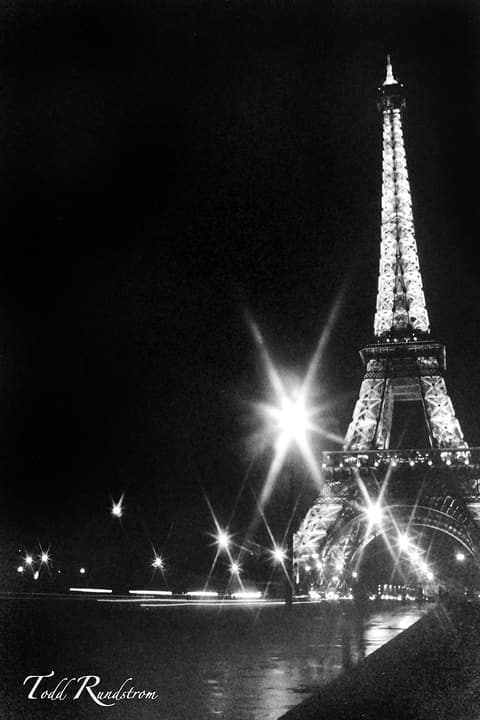
Finding a Ledge Get this as a printI spotted a low stone ledge nearby and walked over to it. Resting the camera on it gave me much better stability than the flat sidewalk. I also adjusted my position so the tower stood straighter and more vertical in the frame.
I was still searching for the right balance — both literally and creatively. With limited film and no way to preview anything, every small improvement felt worth the effort.
-

People at the Base Get this as a printI kept shooting from the same general area but adjusted my position slightly so a group of people walking near the base of the tower entered the frame. Their dark silhouettes stood out against the glowing ironwork and made the tower feel even more massive.
It was another deliberate choice. I liked how the human figures gave the image a sense of scale and life without taking anything away from the tower itself. Every frame still mattered, so I composed carefully, steadied the camera on the ledge, and took the shot.
-

The Ghost Walker Get this as a printI decided to experiment with fill flash to see if I could bring some light into the dark foreground. I popped the flash, and it lit up the stone ledge in front of me — along with a man walking past with an umbrella. The flash froze him mid-step and gave him a strange, ghost-like appearance against the glowing tower behind him.
It was another deliberate choice. I wasn’t just shooting randomly. I was testing what the camera and film could do in these conditions, one frame at a time.
-

The Payoff Get this as a printThis was the last frame I took from this angle, and it was my favorite.
After all the experimenting — changing positions, using the ledge for stability, testing fill flash, and adjusting compositions — this one finally felt right. The tower stood straight and vertical. I had put a star filter on the lens, which gave the bright lights a nice burst. The car trails moved across the bottom of the frame in a way that added energy without overwhelming the tower. And there were no people in the shot to distract from it.
I didn’t know for sure at the time, but I had a good feeling about this one. The work I had put in was paying off.
-

Turning Away Get this as a printI was standing on a bridge overlooking a busy street, and instead of keeping the camera pointed at the tower, I turned it 90 degrees to shoot straight down at the road below.
I set a long exposure and let the cars streak past as bright white lines. It was a completely different kind of shot — no tower, no famous landmark, just the energy of the city moving through the night. I only took one frame like this. Even though I was deep into photographing the Eiffel Tower, I couldn’t resist experimenting with something else while I had the chance.
-
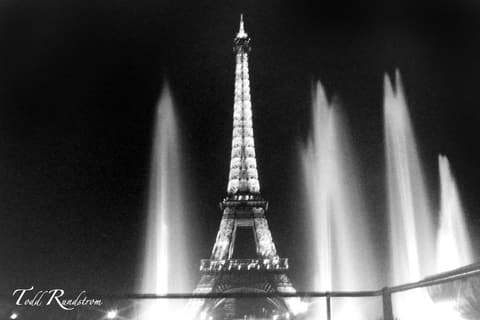
Between the Fountains Get this as a printFor the next frame, I moved in closer to the base of the tower. The fountains were lit up and spraying high into the night air on both sides, creating these glowing white plumes that framed the Eiffel Tower beautifully.
I composed the shot so the tower rose straight up between the two fountains. It felt dramatic and almost dreamlike — the glowing ironwork above, the rushing water below, and the dark Paris sky behind it all.
-
The Jewel of Paris Get this as a printFor my final photograph of my magical day in Paris, I made my way to a viewpoint where I could see the Eiffel Tower in full glory. The tower was lit up brilliantly against the dark sky, and the fountains in front of it were glowing and dancing with light.
I stood there for a long time, just taking it in. At 22 years old, far from home, and still buzzing from everything I had experienced that day — Jim Morrison’s grave, the Louvre, the Metro, the streets of Montmartre, and now this — I felt completely alive. This was the Paris I had dreamed about. This was the moment that made all the miles and all the uncertainty worth it.
I found a place to set my camera for a long 30-second exposure, took a deep breath, and pressed the shutter.
2026Looking Back from 2026
That day in Paris was one of the fullest, most emotionally charged days of the entire trip.
I had arrived the night before with a free apartment to myself, thanks to Olivier’s brother and sister-in-law. I woke up knowing I only had one full day to experience the city, and I was determined to make the most of it. I started at the Palace of Versailles, where the sheer scale and opulence left me stunned. Walking through the Hall of Mirrors and out into those endless gardens, I felt small in the best possible way — like I was standing inside real history.
From there I went straight to Père Lachaise Cemetery to visit Jim Morrison’s grave. That experience was strange and moving. I followed the graffiti deeper into the cemetery, watched fans leave tributes, and witnessed moments I’ll never forget — including a man leaving a burning joint on the grave in tribute and another man picking it up and finishing it as if it were a gift. It was raw, honest, and very 1994. Fans can no longer get as close to him as I did. The whole area has been fenced off for decades — a direct consequence of fans turned vandals who desecrated graves with graffiti.
I spent the afternoon walking across Paris. I stopped into churches, watched street artists and mimes, and felt completely at home among the painters and sketch artists selling their work along the Seine. For the first time on the trip, I remember thinking: I could live here. I could set up right here and sell my photographs.
At the Louvre, I finally saw the Mona Lisa. The crowd was intense, but I stayed long enough to feel her energy and gaze into her eyes. Later, standing beneath the Winged Victory of Samothrace, I was genuinely blown away by the size and power of the sculptures I was witnessing. Everything in that museum felt massive and historical. Before I left, I had a small but meaningful interaction at the information booth that taught me something I’ve carried ever since: a little effort to speak someone’s language goes a long way.
As the sun went down, I wandered into the Red Light District near the Moulin Rouge. I was young, single, and curious. I went inside one of the theaters for a few minutes before deciding it wasn’t for me and stepping back out into the night. From there I made my way up to Sacré-Cœur, where I sat on the steps with hundreds of other people, looking out over the glowing city. It felt peaceful after everything that had happened that day.
I ended the night at the base of the Eiffel Tower.
I spent over an hour there, working the scene. I laid on the ground, used a stone ledge for stability, experimented with long exposures and fill flash, and kept adjusting my compositions. Every frame was deliberate. I had no idea if any of them would turn out. I wouldn’t know for four months, until I was back home in Nebraska developing the film.
But that final frame — the one with the tower rising clean between the glowing fountains, the star filter on the lights, and the car trails moving across the bottom — felt like it had come together. After everything I’d experienced that day, it was the perfect way to end it.
Looking back now, I can see how much that single day in Paris shaped me. I was figuring out who I was as a photographer and as a person. I was learning how to be present, how to stay open, and how to trust my instincts even when I had no way of knowing if anything would turn out.
And somehow, it all did.
I am extremely proud of my photography skills and of myself for getting out into the world and seeing it. I took my camera and documented what I saw. This definitely wasn’t Kearney, Nebraska — this was my education of a lifetime.
Most of all, I am so happy that my negatives are in such pristine condition after all these decades, so that I can share these pictures and memories with you. Rescuing them from my parents’ basement before the fire destroyed everything last summer feels almost like divine intervention right now.