Date
Paris
CountryFrance
- Reading
- 16 min
- Words
- 3,582
- Images
- 25
Part 4: the Musée du Louvre
The Louvre
By the time I reached the entrance, my heart was still full from the walk along the Seine. I had spent the entire day moving through Paris with my camera and my thoughts, and now here I was — standing in front of one of the most famous museums in the world.
I had loved art since I was a kid. Field trips to museums were always the best days of school for me. But nothing could have prepared me for the sheer scale and presence of the Louvre. It was as breathtaking as I imagined and more. It is quite simply incomprehensible until seen in person, and then still overwhelming.
Cameras, thankfully, were allowed, however, of course, flashes and tripods were not.
I bought my ticket and stepped inside, not quite sure where to begin.

The Mona Lisa
Visitors crowd in front of the Mona Lisa. The painting, created by Leonardo da Vinci between 1503 and 1519, is displayed behind thick protective glass.
Da Vinci painted the Mona Lisa in Italy and later brought it with him to France when invited by King Francis I. After his death, the painting entered the French royal collection and has remained in France ever since. It became part of the Louvre’s permanent collection following the French Revolution.
My Photographs from today
The Louvre
-

The Pyramid Get this as a printAs I approached the entrance, I passed through this grand stone archway and saw the glass pyramid rising in the distance.
The pyramid, designed by architect I.M. Pei, was completed in 1989 and stands in stark contrast to the classical architecture of the surrounding palace. On this bright day, the glass structure caught the light dramatically, and people were streaming toward it from all directions.
I stopped for a moment in the shadow of the arch to take this picture before stepping out into the sunlight and joining the flow of visitors heading inside.
-
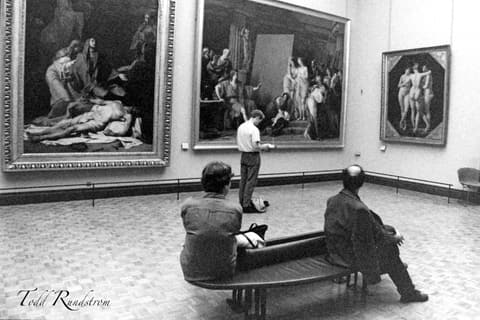
The Grand Galleries Get this as a printInside the Louvre, enormous paintings dominate the walls of the grand galleries. Some canvases are so large they span nearly the full height of the room. Visitors move slowly through the space — some standing close to study the details, others sitting quietly on benches to take in the scale of the work.
-

The Great Hall Get this as a printInside one of the Louvre’s grand galleries, enormous paintings line the walls from floor to ceiling. The room is vast, with a high ceiling and dramatic lighting.
Many of these massive works were originally created for churches or royal palaces across Europe. The Louvre’s collection grew significantly during Napoleon’s era, when thousands of artworks were brought to Paris from conquered territories. Today, the museum displays only a fraction of its holdings — over 380,000 objects in total, with roughly 35,000 works on view at any given time.
In the center of the gallery, visitors sit quietly on a long bench, some studying guidebooks while others simply take in the overwhelming scale of the paintings around them.
-

School Group in the Gallery Get this as a printA group of children, likely on a school visit, gathers closely on the floor in front of a large painting. Some kneel while others sit, all focused on something in front of them — possibly a worksheet or guided activity.
The Louvre regularly hosts school groups, introducing children to art and history through hands-on learning experiences within the galleries. These educational visits are a common sight throughout the museum.
-

At Last, I See Her Get this as a printAfter walking through the long galleries, I finally caught my first real glimpse of the Mona Lisa. She was surrounded by a massive crowd of people all trying to get close.
The scene was chaotic. Hundreds of visitors were packed tightly together, all focused on the small painting protected behind thick glass in the distance. The crowd moved slowly, and the energy in the room felt frantic.
I stood back for a moment and watched the scene before eventually making my way closer.
-
Trying to Get Closer Get this as a printI was working my way through the crowd, trying to move toward the center so I could see the Mona Lisa straight on. It was difficult — people were packed tightly together, and everyone seemed to be pushing forward at once.
Even from where I stood, the painting still looked surprisingly small behind the thick protective glass. I kept moving slowly through the mass of bodies, hoping for a clearer view, but it was a slow and frustrating process.
-

The Real Show Get this as a printAt one point, I turned my camera away from the Mona Lisa and toward the crowd instead. The mass of people — all pressing forward, holding cameras high, trying to get a clear view — was fascinating to watch.
I found myself more interested in the people than in the painting itself. The energy, the chaos, the way everyone was so focused on capturing this one small image… it was a scene worth photographing on its own.
-

Stepping Back Get this as a printThe crowd eventually became too much. People were pushing forward from every direction, and it was hard to even see the painting clearly. I stepped back toward the rear of the room, thinking that I could probably see her just as well on a poster in the gift shop.
Even from back there, though, one thing stayed the same: her eyes seemed to follow me wherever I moved.
-

Film Grain Get this as a printThis photo shows the reality of shooting inside the Louvre with black and white film in 1994. The gallery was dimly lit, and I wasn’t allowed to use a flash. I was shooting handheld, so I had to push the film to its absolute limit to get any kind of exposure at all.
That’s why these images look so grainy. When you push black and white film that far, the grain becomes very visible. It was just the nature of the medium back then — especially in low-light situations like this. There was no digital noise reduction, no high ISO settings, and no second chances.
I accepted the grain as part of the trade-off for being able to capture the moment at all.
-

Her Own Wall Get this as a printThe Mona Lisa is displayed in her own recessed alcove, with an entire wall dedicated solely to her. This is in sharp contrast to the rest of the long gallery, where paintings are hung densely from floor to ceiling, competing for space and attention.
Her isolated presentation makes her feel even more significant — almost like a shrine within the larger museum.
-

Hercules Get this as a printLooking down from an upper level, I spotted this powerful marble sculpture of Hercules. The lion skin draped across his body represents the Nemean Lion, the first of his famous Twelve Labors.
Even from high above, the scale and presence of the figure were impressive. A few visitors had stopped to study it from different angles.
-

Zooming In Get this as a printAs I zoomed in with my lens, the sculpture of Hercules took on a different feeling. The lion skin draped across his body became more detailed, and the sheer size of the figure was even more apparent when seen from this elevated angle.
A few visitors stood close to the base, quietly studying the work. One person appeared to be reading notes. I stayed there for a moment, looking down, before moving on to explore other parts of the museum.
-

Winged Victory of Samothrace Get this as a printThis powerful Hellenistic sculpture is known as the Nike of Samothrace, or Winged Victory. Created around 190 BC, it originally stood on a stone ship’s prow in a fountain on the Greek island of Samothrace. The goddess Nike (Victory) appears to have just alighted on the ship, her drapery dramatically blown back by the wind.
The statue was discovered in 1863 by a French archaeologist and brought to the Louvre in 1866, where it has become one of the museum’s most celebrated masterpieces. Carved from Parian marble, it is renowned for its dynamic movement and the way the wet drapery clings to the body, revealing the form beneath — a hallmark of Hellenistic art.
Though missing its head and arms, the Winged Victory remains one of the most dramatic and celebrated sculptures from the ancient world.
Again, I was blown away by the sheer size of this sculpture. Almost all of the art in this building — except for the Mona Lisa — was massive. Seeing this statue took my breath away.
-

Egyptian Antiquities Get this as a printThis display case is part of the Louvre’s extensive Department of Egyptian Antiquities. The museum houses one of the largest collections of ancient Egyptian artifacts outside of Egypt, with objects spanning from the Predynastic period (before 3000 BC) through the Roman era.
Many of the smaller vessels and objects seen here were used for cosmetics, oils, or ritual purposes. The Louvre’s Egyptian collection grew significantly after Napoleon’s expedition to Egypt in 1798–1801, when French scholars and artists documented and collected thousands of artifacts that eventually made their way into the museum.
-

Looking Up Get this as a printBy this point in the day, I was fully charged. The sheer scale and beauty of everything I had seen had lit something up in me. I felt electrified and creatively inspired — ready to start making my own pictures instead of just looking at everyone else’s.
I began scanning the building for interesting lines, shapes, and perspectives. When I came across this staircase, I stopped and looked straight up. The clean, sweeping curves and the dramatic contrast of light and shadow pulled me in immediately.
I raised my camera and took this picture.
-
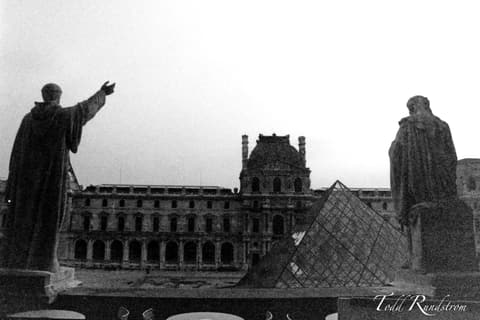
Statues and the Pyramid Get this as a printBy late afternoon, the daylight was beginning to fade. Sunset in Paris that day was around seven, and the museum would soon be closing. I had made my way up to the top floor of one of the wings and paused at a window.
Looking out, I saw this striking view: two large statues framing the scene, the glass pyramid glowing softly in the courtyard below, and the grand historic façade of the Louvre stretching across the far side. It was a beautiful, quiet moment.
-

Overlooking the Courtyard Get this as a printAt sunset, the view from the top floor was breathtaking. The grand courtyard stretched out below, with the glass pyramid glowing softly in the fading light. In the distance, barely visible on the horizon, I could just make out the faint silhouette of the Eiffel Tower. I got goosebumps when I spotted it.
The scale of the Louvre is staggering. Everything visible in this photo is only half of the building — the other half mirrors it on the side where I was standing. And beneath all of this are multiple underground floors. No wonder people say you can’t see the entire Louvre in one day. It truly takes multiple visits to even begin to take it all in.
I raised my camera and took the picture.
-

Zooming In on the Eiffel Tower Get this as a printI switched from my wide-angle lens to my zoom and focused in on the Eiffel Tower, barely visible through the haze in the distance. Standing high up on the top floor of the Louvre, I felt like I was inside a fortified watchtower, gazing out over the city of Paris.
The name “Louvre” itself is believed to come from an old word meaning “watchtower.” In that moment, it felt exactly right. I got goosebumps as I stood there, looking out over the rooftops as the day faded. I felt so alive.
-

Fading Light Get this as a printThe light was fading fast, and the thick, dirty window didn’t help. I knew these exposures wouldn’t be sharp or clean, but I didn’t care. I was too caught up in the moment.
Standing there, looking out over Paris as the day ended, I felt a real connection to the early pioneers of photography — Joseph Nicéphore Niépce and Louis Daguerre. In 1826, Niépce created the world’s first permanent photograph, titled View from the Window at Le Gras, after an eight-hour exposure. After his death, Daguerre refined the process and introduced the daguerreotype in 1839, the first practical form of photography.
In that quiet moment at the window, I felt like I was part of something much older than myself — a long chain of people who were also trying to capture light and hold onto moments before they disappeared.
-

Homage Get this as a printThis frame felt like a direct tribute to the early pioneers. I was doing everything I could — carefully exposing the film, then later developing and printing it — to coax those silver halides into capturing the light that was reaching them. It was slow, deliberate work, and in that moment it felt deeply connected to what Niépce and Daguerre had started over 150 years earlier.
Looking out through the window at the fading light, the distant Eiffel Tower, and the grand architecture of the Louvre and the people walking below, the whole scene felt magical. I stayed there a little longer, just watching, before finally stepping away.
-

The Tower in the Mist Get this as a printI could hear the announcements echoing through the museum — the Louvre was closing, and visitors were being asked to make their way toward the exits. I knew I needed to go, but I couldn’t stop photographing this scene.
The light was shifting quickly, and the Eiffel Tower kept appearing and disappearing through the haze. I stayed at the window, taking frame after frame, not wanting to leave. It felt like the city itself was putting on a final show just for me.
-
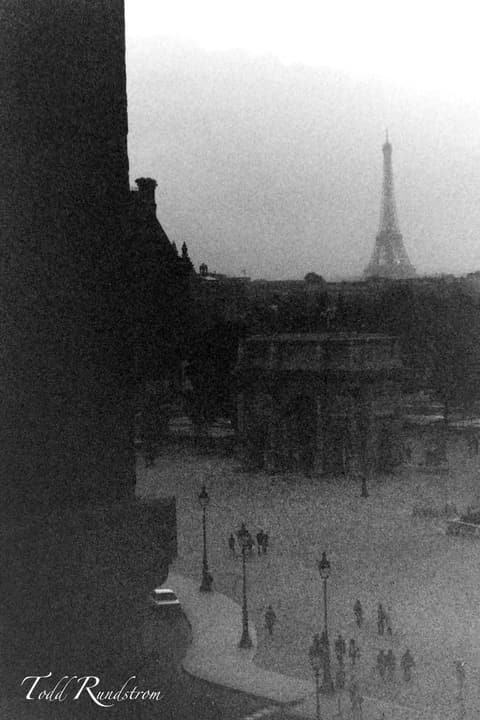
One Final Frame Get this as a printI steadied myself against the wall, pressed the lens directly against the thick, dirty window, and held my breath as I tried to keep the camera as still as possible. Without a tripod, this was the best I could do. I knew the light was almost gone and the image would be soft, but I wanted one last photograph of the Eiffel Tower before I left.
I took the shot, lowered the camera, and put the strap around my neck. Then I turned and hurried toward the exit as the final announcements echoed through the museum.
-

Champs-Élysées at Dusk Get this as a printAfter leaving the Louvre, I stepped back out into the evening air. The sky had darkened, and the city was beginning to glow with lights. I looked down the long, straight avenue of the Champs-Élysées and saw the Arc de Triomphe standing dramatically at the far end, framed by the trees and the wet pavement.
-
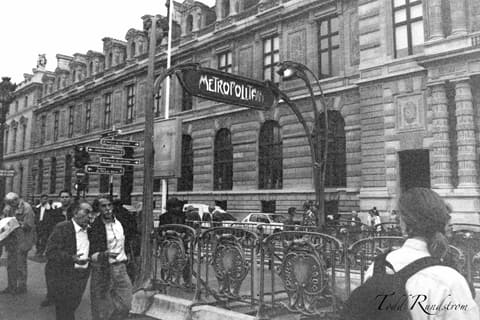
Into the Metro Get this as a printAfter leaving the Louvre, I made my way toward the nearest Metro station. The classic Art Nouveau entrance sign stood out against the grand stone buildings of the Palais Royal area. Evening was settling in, and the city was shifting from daylight into its nighttime rhythm.
I was ready to keep exploring. The Louvre had been incredible, but Paris was much bigger than one museum, and I still had energy and curiosity left in me.
-
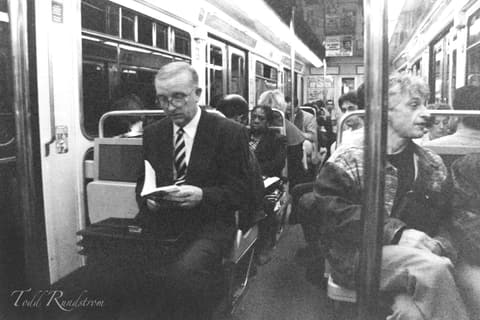
Metro Ride Get this as a printRiding the Paris Metro felt like an amusement park ride to me. I was genuinely enjoying the experience — the smooth motion through the tunnels, the way the train glided from station to station, and the simple novelty of traveling underground.
Most of the other passengers seemed completely unfazed, reading or just sitting quietly as if this was nothing special. But for me, it was still fun. I sat there taking it all in, happy to be moving through Paris this way.
2026Looking Back from 2026
I still hadn’t found my journal at this point, yet this day has remained one of the clearest in my memory. If I did have my diary, this is what I would have written.
By the time I reached the Louvre, I was already emotionally full from the long walk along the Seine. But nothing could have prepared me for the sheer scale of what waited inside.
Before I even made it to the first gallery, I had an experience that has stayed with me ever since.
After buying my ticket, I approached the information booth to ask for directions to the Mona Lisa. Standing just ahead of me were two older American women — loud, demanding, and speaking in thick southern accents. They walked up to the French attendant and barked, “Where’s the Mona Lisa?” The woman behind the counter answered curtly in French and pointed. As the two women walked away, I could hear them loudly complaining to each other about how rude French people were.
Then it was my turn.
I had spent enough time traveling by this time in my life to know that being a guest in another country meant making an effort. So I pulled out my little translation dictionary, did my best with my broken French, and said as politely as I could, “Mademoiselle, I think I have the same question as those women… can you tell me where to find the Mona Lisa, s’il vous plaît?”
The attendant, a pretty woman a few years older than me, looked at me, smiled warmly, and answered in perfect English. She gave me clear directions, handed me a map, and finished with a playful wink.
That small moment has never left me. Since that day, I have always tried to learn at least a few basic phrases in the language of wherever I’m traveling. I’ve found that even a clumsy, sincere attempt to speak someone else’s language is almost always met with kindness — often more kindness than I probably deserve.
It was a good lesson to learn so early in life.
From there, I made my way into the galleries.
The Louvre is not just a museum — it is a city within a city. Construction began on the Louvre in the 12th century under Philip II. Remnants of the Medieval Louvre fortress are visible in the basement of the museum. Due to urban expansion, the fortress eventually lost its defensive function, and in 1546 Francis I converted it into the primary residence of the French kings.
In 1682, King Louis XIV chose the Palace of Versailles for his household, leaving the Louvre primarily as a place to display the royal collection, including a collection of ancient Greek and Roman sculpture.
During the French Revolution, the National Assembly decreed that the Louvre should be used as a museum to display the nation's masterpieces.
The museum opened in 1793 with an exhibition of 537 paintings, the majority of the works being royal and confiscated church property. Because of structural problems with the building, the museum was closed from 1796 until 1801. The collection was increased under Napoleon.
The Musée du Louvre contains approximately 500,000 objects and displays 35,000 works of art in eight departments with more than 652,000 sq ft dedicated to the permanent collection. It is the world’s largest museum.
From the moment I spotted the famous glass pyramid that leads to the entrance to the final moments before it closed and I had to leave, each room left me more in awe than the previous.
Walking through its endless galleries, I quickly understood why people say you cannot see it all in one visit. I had only a few hours, so I moved with purpose toward the two works I most wanted to see: the Mona Lisa and the Winged Victory of Samothrace.
The Mona Lisa was smaller than I expected. After walking past enormous paintings that filled entire walls, her modest size behind thick protective glass felt almost surprising. The room was packed with people pushing forward, many holding cameras above their heads. It was difficult to truly see her. Still, standing there in front of a painting Leonardo da Vinci created nearly 500 years ago, I felt goosebumps. In that moment, I flashed back to sitting in that college classroom six months earlier — lost, depressed, and deciding I was going to drop everything and go to Europe. Now I was doing it, and I knew this would always be one of the very special days in my life.
Since kindergarten, art class had always been my favorite class in school, and when I was old enough to learn specific historic artists, Leonardo da Vinci had always been my favorite. There I stood, 23 years old, gazing into his masterpiece that he had painted nearly FIVE HUNDRED years ago! I get goosebumps thinking about it now.
A short while later, I stood at the base of the Winged Victory of Samothrace. Created around 190 BC, this massive Hellenistic sculpture towers over everyone who climbs the grand staircase. She is enormous, dramatic, and breathtaking. After the delicate, almost hidden presence of the Mona Lisa, her bold scale felt like a completely different kind of power.
Eventually, I made my way to the top floor and found a window overlooking the courtyard. Through the fading evening light, I could just make out the Eiffel Tower in the distance. I pressed my camera lens against the thick, dirty glass and took several photographs. The conditions were poor, but I didn’t care. I wanted to remember that view.
Closing time in the Louvre came much faster than I wanted. When the announcements came that I had to leave, I reluctantly put my camera down and stepped back out into the Paris evening. I walked down the Champs-Élysées as the city lights began to come on, then descended into the Metro and boarded a train. My day at the Louvre was over, but my night in Paris was just beginning.
I was heading towards the Eiffel Tower.