Date
Helsinki
CountryFinland
- Reading
- 8 min
- Words
- 1,908
- Images
- 25
After the excitement and late nights with Siru and Annele, I spent most of Day 70 exploring Helsinki on my own. It was a quiet, solo kind of day — the kind I hadn’t really had much of since arriving in Finland.
I started at the National Museum, where I spent a couple of hours looking at suits of armor and the oldest surviving manuscript in Finland. From there I walked over to the Helsinki Cathedral again, then visited the Orthodox Church. I also spent time at both the university library and the public library, catching up on news and magazines — something I hadn’t done in weeks.
It felt good to move at my own pace for a change. No schedules, no pressure, just walking around the city with my camera and taking things in. Later that evening, after coming home and watching a rerun of Home Improvement (which felt strangely comforting), Annele and I sat and talked for hours about life, Australia, and what it had been like adjusting back home after our exchange year.
It was a simple day, but it was exactly what I needed.
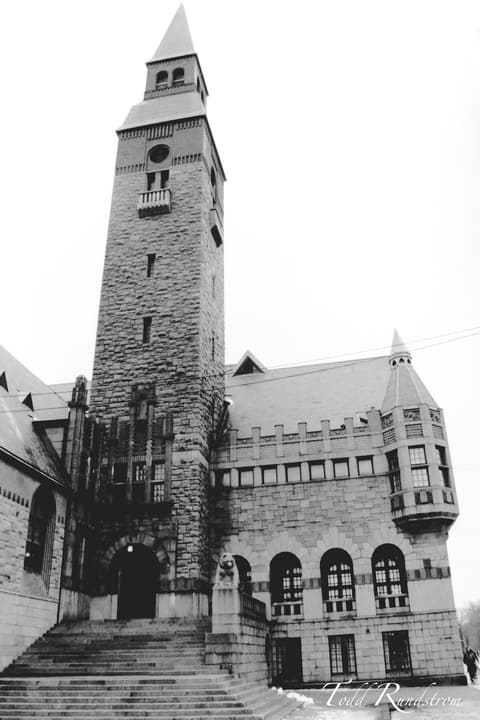
The National Museum of Finland, Helsinki
Completed in 1910, the National Museum of Finland stands as one of Helsinki’s finest examples of National Romantic architecture. The building draws inspiration from Finland’s medieval stone churches and castles. Its commanding tower, intricate stonework, and powerful lion guardians at the entrance reflect the spirit of Finnish independence and cultural identity during the early 20th century. The museum houses extensive collections that trace Finland’s history from prehistoric times to the modern era.
My Photographs from today in Helsinki, Finland
-

Drawbridge Ahead Get this as a printAnother one of those small but striking details that reminded me I was a long way from Nebraska. I’d never seen a road sign warning of a drawbridge before. Back home, we didn’t have canals or rivers that lifted up for ships to pass through. Seeing this sign while walking through an industrial part of Helsinki, with those big smokestacks in the background and the cold gray sky overhead, felt like another quiet confirmation that I was really in another world. Everything — the roads, the signs, the buildings, even the way the city met the water — looked and felt different from anything I knew.
-

Kamppi Metro Station Escalators Get this as a printThis was the long escalator at Kamppi Metro Station, right in the heart of downtown Helsinki. I remember being struck by how far it went — it felt like one of the longest escalators I’d ever ridden. The steep angle, the rows of bright fluorescent lights overhead, and the way the people ahead of me kept getting smaller made it feel almost cinematic.
-

Mannerheim Statue Get this as a printThis is the famous equestrian statue of Carl Gustaf Emil Mannerheim (1867–1951), Finland’s most celebrated military leader and statesman. It stands on Mannerheimintie, right in front of the Parliament House of Finland. Mannerheim led Finland’s forces during the Winter War and the Continuation War, and later served as the country’s president. The statue, unveiled in 1960, has become one of Helsinki’s most recognizable landmarks.
-

Parliament House of Finland Get this as a printThis is the Eduskuntatalo, Finland’s Parliament House. I remember being impressed by how massive and solid it looked — that long row of tall columns and the heavy stonework gave it real presence.
-

Fully Enclosed Phone Booth Get this as a printA classic glass-enclosed phone booth marked with the words TELEFON and PUHELIN, the Finnish word for telephone. These fully protected booths offered privacy and shelter from the cold, a noticeable contrast to more open designs.
-

Framing the Tower Get this as a printI stepped inside the phone booth and tried to line up the shot so the museum tower would sit perfectly in the window. The glass was a little dirty and the phone took up part of the frame, but I liked the idea of capturing the old stone tower from inside this small glass box.
-
The National Museum of Finland Get this as a printStanding at the foot of this massive stone fortress in Helsinki, I felt the weight of real history pressing down on me in the best way. That tall tower, the lion standing guard at the entrance, the grand staircase — it all felt ancient and serious. After weeks of moving fast from one city to the next, this place slowed me down. I walked through centuries of Finnish life inside.
-

Suits of Armor Get this as a printThese three suits of armor are part of the National Museum of Finland’s collection of historical military equipment. The style and construction suggest they date from the late medieval to early modern period, roughly the 15th to 17th centuries. The display also includes additional helmets and pieces of plate armor, along with a wall of period weapons.
-

Full Suit of Plate Armor Get this as a printThis complete set of plate armor is a classic example of European knightly equipment from the late 15th to early 16th centuries. Made from hardened steel plates, it was designed to protect the wearer from sword cuts, lance thrusts, and early firearm projectiles while still allowing a reasonable range of movement. The helmet features a hinged visor with vertical slits for vision and ventilation, and the articulated gauntlets show careful craftsmanship to protect the hands without sacrificing dexterity. Such armor was expensive and typically worn by wealthy knights or men-at-arms during the final centuries of the medieval period.
-
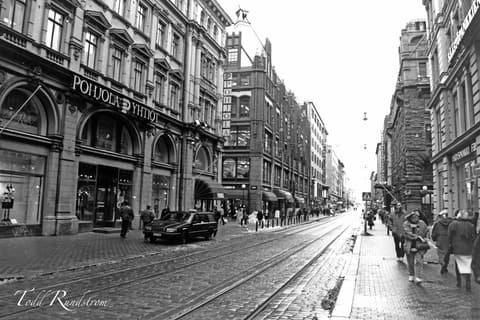
Pohjola Building Get this as a printThis is a classic view looking down one of Helsinki’s main central streets. The large building on the left with the prominent “POHJOLA-YHTIÖT” sign is the historic Pohjola Insurance building, a fine example of early 20th-century Finnish architecture. The tram tracks running down the middle of the street, the ornate facades on both sides, and the mix of people walking and going about their day give a strong sense of everyday life in the city center.
-
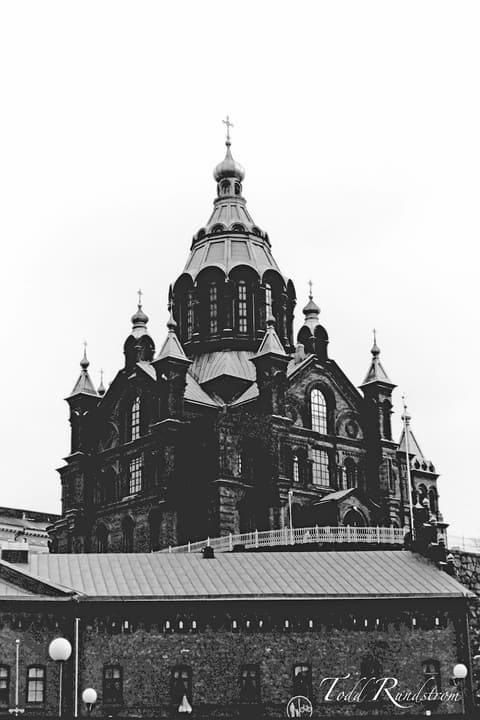
Uspenski Cathedral Get this as a printThis is the Uspenski Cathedral, Helsinki’s most prominent Russian Orthodox church. Built in the late 19th century from red brick and topped with distinctive golden onion domes, it stands as a striking reminder of Finland’s historical ties to Russia. The cathedral’s dramatic location on a rocky hill near the harbor makes it one of the city’s most recognizable landmarks.
-

Cathedral on the Rock Get this as a printThis view shows the Uspenski Cathedral dramatically perched on a large rocky outcrop above the city. The cathedral’s red brick and golden domes stand out sharply against the pale winter sky, while the bare tree branches frame the scene on either side. Its elevated position on the rock makes it one of Helsinki’s most striking landmarks, visible from many parts of the city center and harbor area.
-

Side View of Uspenski Cathedral Get this as a printThis angle shows the curved eastern end of the Uspenski Cathedral, with its smaller onion domes and arched windows. The white decorative iron fence in the foreground adds a delicate contrast to the massive red brick structure behind it. From this side, you can clearly see the rounded apse and the layered rooflines that give the cathedral its distinctive Russian Orthodox silhouette.
-

Decorative Crosses and Brickwork Get this as a printThis close-up shows the rich red brickwork and architectural details of the Uspenski Cathedral. The large decorative Orthodox crosses are a prominent feature on the exterior walls, standing out against the textured brick surfaces. The arched windows and layered brick patterns reflect the high level of craftsmanship that went into the cathedral’s construction in the late 19th century.
-

Helsinki Cathedral Get this as a printThis is the Helsinki Cathedral, the large white neoclassical Lutheran church that dominates the city’s skyline. Sitting high above Senate Square, its prominent central dome and four smaller towers make it one of Helsinki’s most recognizable landmarks. From this viewpoint across the rooftops, you can see how it rises above the surrounding buildings, giving it a commanding presence over the city center.
-

View Toward Helsinki Harbor Get this as a printThis high vantage point looks out over central Helsinki toward the harbor. In the foreground are typical city rooftops with skylights, while a wide street stretches toward the water. Small boats are moored along the quay, and in the distance you can see larger ships and the industrial silhouettes of cranes and smokestacks along the waterfront.
-

Two Cathedrals of Helsinki Get this as a printThis composition nicely captures the contrast between Helsinki’s two main cathedrals. In the foreground stands the red brick Uspenski Cathedral, with its rounded apse and distinctive Russian Orthodox architecture. In the background, rising above the city, is the white neoclassical Helsinki Cathedral with its prominent dome. The two buildings represent very different architectural traditions and religious histories, yet they both dominate Helsinki’s skyline in their own way.
-

One Last Look Get this as a printAs I walked away, I couldn’t resist taking one more picture of this gorgeous church. Even from a distance, the Uspenski Cathedral still dominated the view, rising above the street and traffic. I had already taken several photos of it that day, but something about seeing it framed by the city made me stop one final time before moving on.
1994From my journal
DAY 70 / 11-15-94Helsinki, Finland - Day 4
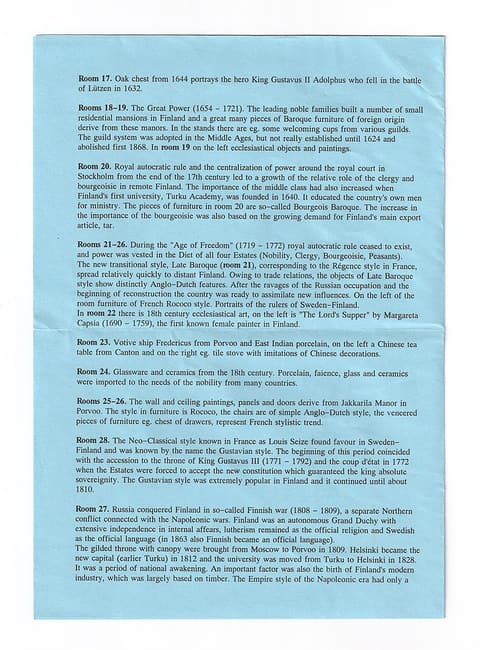
I woke up at 11:30 and set out to see Helsinki. First stop was the Finland National Museum, where I saw the oldest surviving manuscript in Finland (dating around 1410) and suits of armor from the 14, 15 and 1600’s. The really nice thing was it was free.
After an hour or two there I walked over to the Helsinki Cathedral again & then to the Orthodox Church, where I think I took some awesome pictures.
Next I went to the University Library and read the articles in TIME magazine that I didn’t get to yesterday. Then, after talking to the librarian and getting directions, I walked to the public library. There I read the International Herald-Tribune, Newsweek, and Rolling Stone.
After taking a bath when I got home, I channel surfed (through three stations – it didn’t take long) and found “Home Improvement”! It was a rerun, but a good one. I’ve still only seen two “The Simpsons” episodes, and one was in French, so I’m really anxious to have a “Simpsons” night, sponsored by MGD [Miller Genuine Draft], with the Dome Crew when I get home.
Annele got home at 8:30, and we talked about life & Australia & America for the rest of the night.
JournalMy handwritten journal pages · 2 pages
-

-

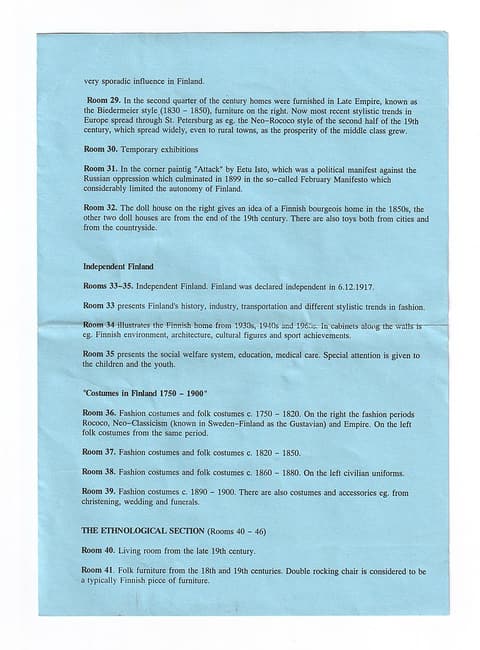
ScansThe National Museum of Finland guide - pg · 4 pages
-

-
-
-


2026Looking Back
This was one of the quieter days of the trip, and I needed it.
After the intensity of the previous weeks and the late nights with Siru and Annele, spending the day on my own exploring Helsinki felt grounding. Walking through the National Museum, visiting churches, and sitting in libraries reading magazines gave me a rare sense of normalcy. It was the kind of day that reminded me why I had wanted to travel in the first place — not just to see new places, but to have time to think and process.
The conversation I had with Annele that evening was especially meaningful. Talking with someone who had gone through the same exchange experience helped me reflect on how much I had changed since Australia, and how much I still had to figure out when I eventually went home.
These calmer days in Helsinki were quietly important. They gave me space to breathe.