Date
Helsingør → Århus
CountryDenmark
- Reading
- 11 min
- Words
- 2,563
- Images
- 34
An Unexpected Stop at Elsinore
One of the best parts of traveling with no fixed plans was that I could follow whatever caught my interest. On this day, I experienced one of those perfect spontaneous moments.
I was on my way from Lund, Sweden, to Århus, Denmark. I knew my final destination, but I didn’t know I would end up visiting Kronborg Castle — the real-life castle that Shakespeare used as the setting for Hamlet. In the play, it’s called Elsinore.
While on the ferry crossing back into Denmark, I met a guy who strongly recommended I stop and see the castle. So I did.
It was surreal walking through the same halls and courtyards that Shakespeare had written about nearly 400 years earlier. I even tried making a Strange Brew joke to the older woman working the ticket counter (she didn’t get it). Later, during the tour, I learned that there actually was a beer called Elsinore brewed there at one point — which made the Bob and Doug McKenzie reference even funnier to me.
I also got to see the famous dungeons and learned about Holger the Dane, Denmark’s legendary national hero. It was one of those days where history, pop culture, and random travel collided in the best way possible.

Kronborg Castle, made famous by William Shakespeare as Elsinore Castle in “Hamlet,” in Helsingør, Denmark.

My Photographs from today traveling through Helsingør to Århus, Denmark
-

Rural Tracks and Golden Arches Get this as a printThis was the view from the train platform in Lund. Up ahead were classic Swedish countryside tracks disappearing into the trees, while right below on the platform was a McDonald’s sign. It was a funny little contrast — the quiet, old-world scenery in front of me mixed with a very modern, American fast-food presence right at my feet.
-

Keeping Sweden Clean Get this as a printOne of my last impressions of Sweden was how incredibly clean everything was. Early in the morning on the train platform in Lund, I watched this custodian methodically sweeping the entire platform by hand. It wasn’t a machine doing the work — it was just this man with a broom, quietly keeping the station spotless. I really respected that level of care and pride in public spaces.
-

Morning Maintenance Get this as a printAnother view of the custodian working on the platform in Lund. I really admired how seriously he took his job — methodically sweeping the entire length of the platform by hand, right along the edge of the tracks.
-

The Long Platform Get this as a printFurther down the tracks, the custodian continued his slow, steady work. He had already swept a long stretch of the platform and was still going. Watching him methodically clean the entire length by hand, early in the morning and in the cold, really stuck with me. It was a quiet but powerful example of pride in one’s work.
-

Harbor Cranes Get this as a printThese giant cranes along the water’s edge were something I never saw back in Nebraska. I was drawn to their scale and the way they dominated the skyline. Standing there looking at them felt like another small but clear reminder that I was far from home, in a place built around shipping and industry instead of farming and open land.
-
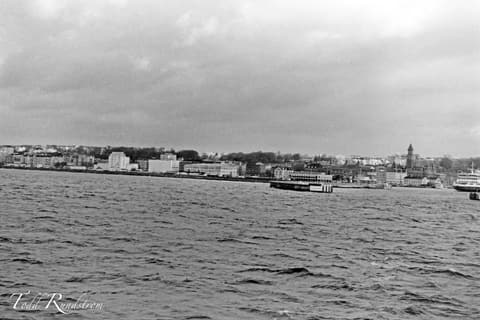
Leaving Sweden Get this as a printThe view from the ferry as I crossed back into Denmark. Sweden was slowly disappearing behind me under a moody sky. It was one of those in-between moments on the trip — not quite in one place anymore, and not yet in the next.
-

Picnic Tables on the Ferry Get this as a printOne of the things that surprised me on this crossing was seeing actual picnic tables set up on the open deck. People were sitting around them casually, like it was no big deal. After everything I had been through the night before, and with my ongoing nervousness about being on the water, it felt surreal to see everyone so relaxed. It was a very European way to travel that I wasn’t used to.
-

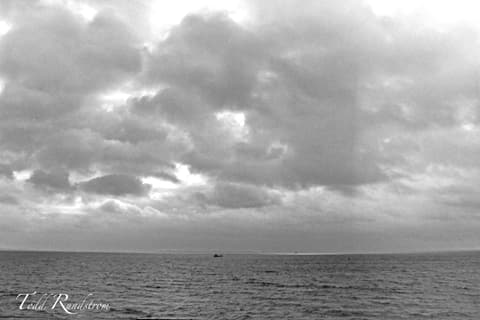
Crossing the Øresund Strait Get this as a printThese five photos are my attempts to capture the mood of the ferry crossing from Sweden back into Denmark. As we moved across the Øresund Strait — the body of water that separates the two countries — I became fascinated by the dramatic sky, heavy clouds, and dark, rolling water. While I took several shots during the crossing, the one where the sun finally broke through the clouds and lit up the surface of the sea was my favorite.
-

Get this as a print -

Get this as a print -

Get this as a print -
Get this as a print -
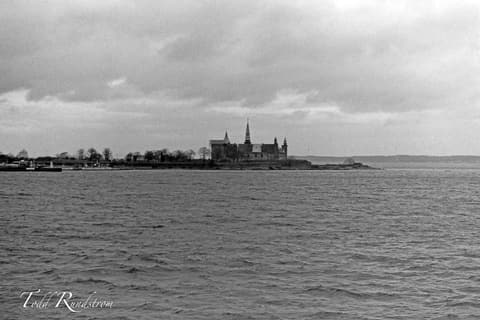
Spotting Kronborg Castle As the ferry crossed the Øresund Strait, Kronborg Castle slowly came into view on the Danish shoreline. This is the real-life castle that William Shakespeare used as the setti Get this as a printSpotting Kronborg Castle
As the ferry crossed the Øresund Strait, Kronborg Castle slowly came into view on the Danish shoreline. This is the real-life castle that William Shakespeare used as the setting for Hamlet, which he called Elsinore. Originally built in the 1420s as a fortress to control maritime traffic and collect tolls from ships passing through the strait, it was later transformed into a grand Renaissance castle. Seeing it appear through the mist and clouds felt like history coming to life right in front of me.
-

The Fortress Walls Get this as a printKronborg Castle is protected by massive brick fortifications and a real, functioning moat. Originally constructed in the 1420s as a fortress to control maritime traffic and collect tolls from ships passing through the Øresund Strait, it was later transformed into a grand Renaissance castle while maintaining its role as one of the most powerful strongholds in Northern Europe during the 16th and 17th centuries.
-
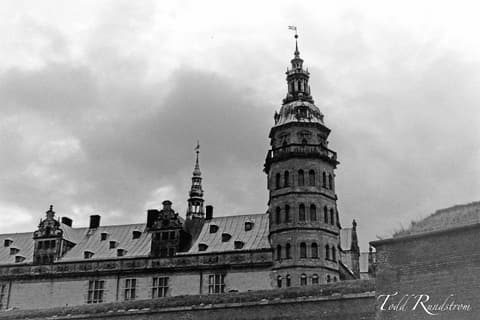
Kronborg’s Tower Get this as a printThis is one of Kronborg Castle’s most distinctive towers, rising high above the main building with its ornate spire and copper roof. When King Frederik II rebuilt the original medieval fortress into a grand Renaissance castle between 1574 and 1585, he added these impressive towers and spires to showcase royal power and wealth. The castle’s dramatic silhouette became iconic — and later world-famous as the setting for Shakespeare’s Hamlet.
-

Tower from the Courtyard Get this as a printStanding in Kronborg’s main courtyard, this view captures the full height of its tallest and most ornate tower. King Frederik II’s major rebuilding project in the late 1500s turned the old fortress into a magnificent Renaissance palace, complete with these impressive towers meant to showcase royal power. Its dramatic appearance later made Kronborg the perfect real-life setting for Shakespeare’s Hamlet.
-

From the Tower Get this as a printThis view from high inside one of Kronborg’s towers looks down over the main courtyard. The castle’s tall towers were added during King Frederik II’s major rebuilding project in the late 1500s, both to display royal power and to provide commanding views over the Øresund Strait. From up here, the full size and strength of the fortress become very clear.
-

Get this as a print -

Cannons Over the Øresund Get this as a printThese cannons lined up along Kronborg’s ramparts were once used to enforce one of the most profitable toll systems in European history. For nearly 400 years (1420s–1857), Denmark collected “Sound Dues” from every ship passing through the narrow Øresund Strait between Denmark and Sweden. If a captain refused to pay, the cannons at Kronborg would fire warning shots — or worse — to force compliance. The castle’s strategic location at the narrowest point of the strait made it the perfect place to control maritime traffic entering and leaving the Baltic Sea.
-

The Great Hall Get this as a printThis is Kronborg Castle’s famous Great Hall. At 203 feet long, it was the largest hall in Northern Europe when it was completed in 1582. King Frederik II built it to host grand banquets, diplomatic events, and royal celebrations. The black-and-white checkered floor, massive chandeliers, and large historical paintings on the walls all reflect its original purpose as a space to impress visitors and display the wealth and power of the Danish crown.
-

Inside the Casemates Get this as a printThis photo was taken inside Kronborg’s famous casemates — a network of underground tunnels and defensive corridors built beneath the castle. These thick, vaulted passages were designed so that soldiers could take shelter during sieges, store weapons and supplies, and even house prisoners. In times of attack, up to 350 men could hide here with enough provisions to last for weeks. The casemates were a critical part of Kronborg’s military strength, allowing defenders to remain protected while still being able to fight from within the fortress.
-

Neptune at Kronborg Get this as a printThis is a statue of Neptune, the Roman god of the sea, holding his trident. It is located on the exterior of Kronborg Castle. Given the castle’s strategic position overlooking the Øresund Strait — and its long history of controlling maritime traffic and collecting tolls from ships — Neptune was a fitting figure to display. The statue reflects the Renaissance-era emphasis on classical mythology and the importance of sea power to the Danish crown.
-
Kronborg Castle Get this as a printThe full exterior of Kronborg as seen from outside the ramparts. Originally constructed in the 1420s to control the Øresund Strait and collect Sound Dues from ships, it was transformed in the late 1500s by King Frederik II into a magnificent Renaissance castle. The long sandstone facade, spires, and grand main gate were meant to impress visitors and symbolize Danish power.
-

Framed by the Arch Get this as a printThis was my last photo at Kronborg Castle. I loved how this stone arch created a natural frame for the entire castle. Standing there looking through it felt like the perfect way to end my visit — seeing the full grandeur of the towers, spires, and long facade one final time.
-
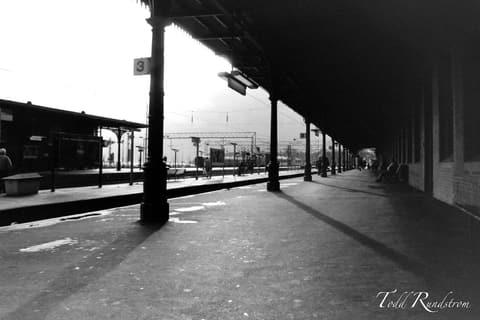
Platform 3, Helsingør Get this as a printAfter spending the afternoon exploring Kronborg Castle, I returned to Helsingør Station for the long train ride across Denmark to Århus. This photo was taken on Platform 3 as I waited for my train. The long, empty platform and the strong afternoon light gave it a quiet, almost cinematic feel. I had about a seven-hour journey ahead of me, but I was excited — Pernille was waiting for me at the other end.
1994From my journal
DAY 56 / 11-01-94Traveling toÅrhus, Denmark
Today wasn’t too bad. I got up at 8 as Joe was getting ready to leave for school. By 9 I had packed and was leaving also. I had to walk to the train station, but along the way I stopped at a store for some food & the post office to mail Tracy a letter.
The train left at 10:08, and after taking the ferry I was back in Helsingør by 11:30. This was the town of Elsinore in Shakespeare’s “Hamlet” and also the name of the brewery in Bob & Doug McKenzie’s movie “Strange Brew.”
On the ferry I met some guy from N.Y., who like me, had gone backpacking in his early 20’s. He had fallen in love (both with a person & the place) and has stayed for 30 years. He suggested that I visit Kronborg Slot, the magnificent castle that sits on the water’s edge.
So I walked to the castle and when I entered the entrance I found a woman in at least her 80’s sitting at the ticket window.
I walked up to her and said “I was like, uh, drinking some of your Elsinore beer, right? And uh, one of the bottles had, like, a mouse in it, and I uh, heard once that if that happens, right, you have to like, give me some free beer, so, uh, hand it over, eh?”
And she said “Take off you Hoser! Elsinore Beer hasn’t been brewed here for like, a long time, eh, so I know you’re lying, O.K.?!”
Note from me in 2024:
This is a reference to the 1983 movie “Strange Brew.” See below for links to scenes from the TV sketches and movie that put this joke into context. I watched these comedy sketches about the Great White North and this movie dozens of times with my sister Tracy, and it still makes us laugh to this day!
Of course she didn’t say that, but I did find out from the tour guide that there really was a beer called Elsinore. But they didn’t make it anymore. Also, he had heard of Shakespeare but had no clue who Bob and Doug McKenzie were.
The castle was built in 1425, and one of the coolest things were two huge globes from 1640. It was really interesting to see how they thought the land masses were back then.
The other cool thing was the tour of the dungeons, where I met Holger the Dane, the country’s national hero (and no doubt the inspiration for the comic strip Hagar the Horrible).
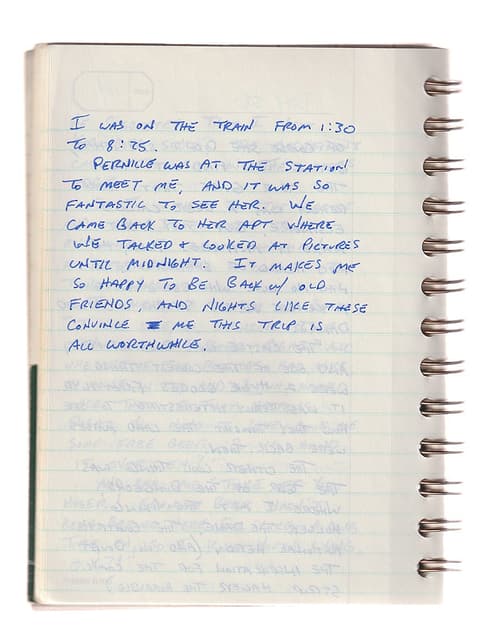
I was on the train from 1:30 to 8:25.
Pernille was at the station to meet me, and it was so fantastic to see her. We came back to her apartment where we talked and looked at pictures until midnight.
It makes me so happy to be back with old friends, and nights like these convince me this trip is all worthwhile.
Click on the following screenshots to watch clips from “Strange Brew” on YouTube.
JournalMy handwritten journal pages · 4 pages
-

-

-

-



2026Looking Back from 2026
This was one of those days that felt light in the best way.
After the chaos and fear of the night before at The Slaughterhouse, waking up and simply moving through the day felt like a reset. I had no big plan when I left Lund — just a train ticket and the vague idea of getting to Århus. But somewhere along the way, the day took on its own shape. I’m so glad that stranger I met on the ferry encouraged me to go visit the castle. I was genuinely happy he did. That one small interaction sent me on a completely different path for the day.
What stayed with me most wasn’t just the history itself, but how alive everything felt. I wasn’t just reading about places anymore — I was standing in them.
And then there was the Strange Brew moment.
When I made that silly Bob and Doug McKenzie joke to the woman at the ticket counter, it wasn’t random. Strange Brew was a legitimate Dome Classic. We watched that movie over and over in our own little home theater in the basement of The Dome — so many times I lost count. It was one of Curt’s favorites, and when I watch these clips on YouTube, I can still picture him smiling and I can hear him laughing. Standing there at Kronborg, making that joke out loud, felt like a weird little love letter to home then. And remembering this moment and my connection to Curt, this is one of those small, unexpected moments where the trip and my real life overlapped in the best way.
After a long train ride across Denmark, seeing Pernille waiting for me at the station in Århus felt like pure joy! We stayed up until midnight just talking and looking at pictures. I was so happy to see her again.
Looking back now, I can see that this day was part of the slow, steady work the trip was doing on me. It wasn’t a turning point in any obvious way. But it was another brick in the new foundation I was quietly rebuilding.