Date
Belfast
CountryNorthern Ireland
- Reading
- 20 min
- Words
- 4,550
- Images
- 40
The morning after my powerful day at Windmill Lane, I woke up early and boarded a train heading north — across the border into Belfast, Northern Ireland. Country number two for me, and I was excited to my core!
Just ten days earlier, the IRA had announced a ceasefire. The city was tense but hopeful, with British soldiers carrying machine guns on nearly every corner and armored vehicles rolling through the streets. The scars of decades of “The Troubles” were impossible to ignore.
And there I was — a 22-year-old kid from Nebraska with nothing but a backpack, a camera, and more courage than common sense — walking straight into it. I wanted to learn and photograph as much as I could in my afternoon there.
I actually walked up to armed British soldiers and asked if I could take their portraits. I wasn’t just passing through Belfast. I wanted to feel it. I wanted to understand it. I wanted to stand in the middle of history.
This wasn’t just another tourist stop. This was one of the most intense, eye-opening, and unforgettable days of my entire adventure.

British Soldier on Guard
A British soldier stands guard in front of a courthouse that had been damaged by the IRA.
The scars of The Troubles were still very visible in Belfast in September 1994 — just days after the IRA announced a ceasefire. I was nervous but determined. I walked right up to this soldier, told him I was a young American traveling through Belfast with my camera, and asked if I could take his portrait. To my surprise, he agreed. In the few moments I visited with him, I asked him what he was doing there. I remember feeling calmer when he said he was there to protect people.
Looking back, I’m still amazed at the boldness of that 22-year-old kid from Nebraska — standing face-to-face with an armed soldier in the middle of a city still healing from decades of conflict.
This single image captures the tension and the fragile hope of that moment better than any other.
My Photographs from today in Dublin and Belfast
-

Morning in Dublin Get this as a printI woke up early, left my big backpack at the hostel, and grabbed just my camera bag. As I walked toward the train station, the tall, beautiful spire of St. Patrick’s Cathedral rose above the quiet streets.
It was a calm, peaceful morning in Dublin — the city still waking up. I was still carrying the magic from the night before at Windmill Lane, and I was excited to experience Belfast.
-

A Street Sweeper at Dawn Get this as a printAs I walked toward the train station in the early morning light, I was astounded.
A man was already out sweeping the street clean — before the sun had even fully risen. The dedication and quiet pride in his work struck me. In that moment, I realized how seriously the Irish took keeping their city beautiful.
Behind him, the tall, elegant spire of St. Patrick’s Cathedral rose above the rooftops, watching over the waking city.
-
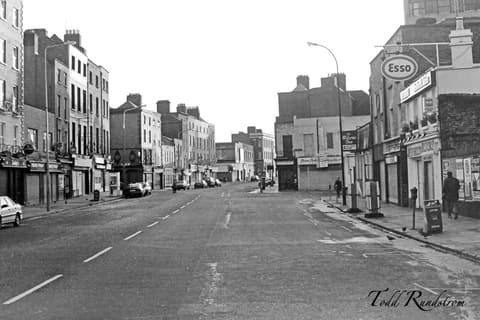
Early Morning in Dublin Get this as a printThe city was calm and quiet.
As I walked toward the train station, the city felt almost empty. Shops were still closed, the streets were nearly deserted, and only a few early risers were out.
It was peaceful - a contrast of what I was about to see across the border in Belfast.
-

Sunrise at the Train Station Get this as a printAs I waited for the train to Belfast, the rising sun began to flood the platform with light.
The elegant iron arches of Dublin Connolly Station framed the golden sunrise perfectly, creating a peaceful and cinematic moment.
The air was cool and still. I stood there with my camera, capturing the light pouring through the old station architecture, and felt a quiet excitement building inside me as I clicked the shutter.
-
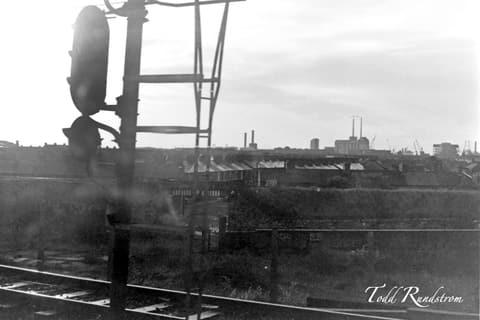
Leaving Dublin Get this as a printAs the train slowly pulled out of the station, I pressed my face to the window and watched the city slide past.
The view was raw and industrial — railway signals, rooftops, smokestacks, a grittier side of Dublin. The train picked up speed, and I felt a quiet mix of excitement and nervousness building in my chest.
-

Heading North Get this as a printDublin disappeared behind me as the train continued north toward Belfast.
I slipped on my headphones and put on The Joshua Tree. The music that had carried me through so many dark nights back home was now the perfect companion for this real-life journey north.
-

Poolbeg Power Station Get this as a printAs the train continued north out of Dublin, the landscape opened up and I spotted something on the horizon.
This is Poolbeg Power Station — one of Dublin’s most famous and recognizable landmarks. Construction began in 1965, with the first chimney completed in 1971 and its twin in 1977. At over 207 meters tall, these iconic red-and-white chimneys became a defining feature of Dublin’s skyline for decades.
The train slowly passed through this gritty, working part of the city, and I remember thinking how different this felt from the beautiful, historic Dublin I had just left behind.
The peaceful morning was now fully behind me. The real journey was beginning.
-

A Face in the Glass Get this as a printAs the train moved through the Irish countryside, something caught my eye.
The window had become a mirror. Reflected in the glass was the quiet, thoughtful face of the man sitting in the seat ahead of me — completely unaware he was being seen.
I loved these accidental moments. The way light, glass, and timing could create something so intimate and beautiful without anyone knowing. It felt like a secret little gift from the journey itself.
I gently raised my camera and captured it, feeling grateful for the quiet magic that kept appearing along the way.
-

Breakfast on the Train Get this as a printThis was completely new to me.
On the way to Belfast, the train had a small rolling snack cart that came through the carriage selling tea, coffee, sandwiches, and snacks. I had never experienced anything like this before — buying food and drinks while rolling through the Irish countryside.
I sat in my seat for a moment, a little unsure of the process, watching the attendant behind the cart. It felt both exotic and strangely normal at the same time.
-
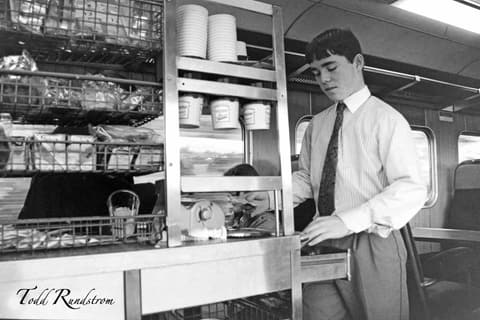
The Young Man at the Cart Get this as a printThis young man was about my age — 22 or so — working the rolling snack cart on the train to Belfast.
I stood there watching him and thought: What an interesting job this must be. Rolling through the Irish countryside every day, meeting travelers from all over, serving tea and sandwiches while the landscape changed outside the window.
We had absolutely nothing like this in Nebraska. No commuter trains. No breakfast on trains. All we had were freight trains. This felt exotic and wonderful to me.
I loved capturing this quiet moment of someone just doing their job — and wondering what stories he might have collected from all the miles he traveled.
-

Belfast Central Station Get this as a printThe train slowed and pulled into Belfast Central Station.
Opened in 1976, this was a relatively new and modern station for its time, built on the site of the old Belfast Central Railway line that dated back to the 1870s. With its distinctive iron and glass roof and elegant Victorian-style architecture, it served as the main gateway into Northern Ireland.
As I looked out the window at the platform, I felt a mix of excitement and nervousness. I had finally arrived in Belfast — the city I had heard so much about on the news back home.
-
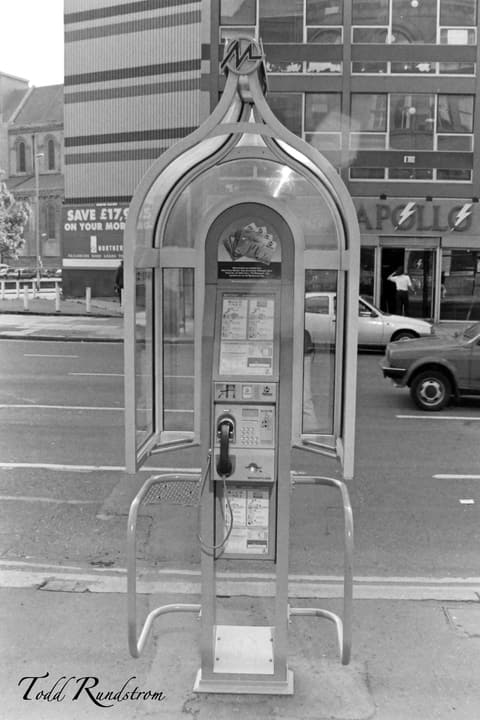
A Phone Booth Sculpture Get this as a printStepping outside Belfast Central Station, I was completely fascinated when I spotted this phone booth.
It wasn’t just functional — it was a Mercury Communications booth with an elegant, sculptural design featuring curved glass and a graceful metal frame. In 1994, it felt incredibly modern and artistic.
I stood there staring at it for a moment, struck by how different this was from anything I had seen before. It was one of those small details that made the trip feel so alive and full of surprises.
I couldn’t resist taking a photo. Even the smallest things were blowing my mind.
-

The Classic Mercury Phone Booth Get this as a printJust down the street, I spotted a more traditional phone booth — the kind you actually step inside of.
This one had a beautiful etched figure of Mercury blowing his trumpet on the glass door. It was a Mercury Communications phone booth, a more classic design compared to the sleek sculptural one I had just seen earlier.
I loved how the phone company was mixing art into traditional spaces. It was yet another small detail that made Belfast feel so vibrant and full of surprises.
-
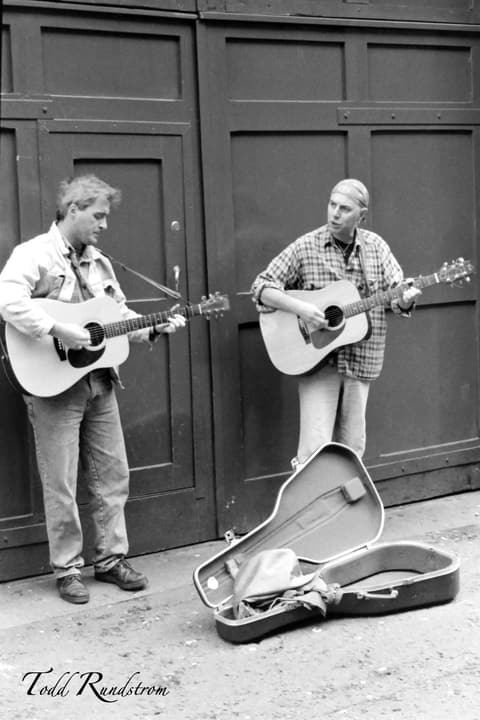
Busking in Belfast Get this as a printI came across these two guys playing on the street and stopped to listen.
One played lead guitar while the other sang and played rhythm. Their open guitar case was on the ground, collecting coins from people walking by. They were really entertaining — great voices, good energy, and clearly having fun together.
I stood there for a while, smiling and tapping my foot. This felt like a breath of fresh air. Music like this had a way of cutting through everything.
-

Toilets Beneath the Street Get this as a printIn the middle of a busy Belfast street stands the entrance to a set of underground public toilets.
These subterranean facilities were a common Victorian solution in densely built-up cities across the UK and Ireland. With limited space above ground, local authorities built public conveniences beneath the road surface, accessed by stairs and lit by glass bricks in the pavement.
The ornate black railing and clear “Toilets” sign mark one of many such installations that exist in Belfast. In the background rises the grand dome of Belfast City Hall.
These underground public conveniences were part of a major 19th-century push to improve public health and sanitation in rapidly growing cities.
-

A Bygone Era Get this as a printHere is the entrance to another set of underground public toilets.
Built beneath the road to save valuable space above ground, these subterranean facilities were a common Victorian solution in many British and Irish cities. In 1994, when this photo was taken, most were still in use.
However, by the early 2000s, most had been shut down due to high maintenance costs, vandalism, and changing public habits. Today, almost all of them have been sealed, filled in, or left to deteriorate.
-
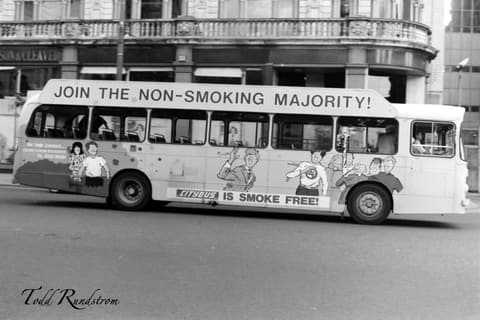
The Cheerful Anti-Smoking Bus Get this as a printThis bright white Citybus stood out on the streets of Belfast with its bold message and playful cartoon characters celebrating a smoke-free life.
In 1994, seeing a bus like this was still somewhat unusual. Smoking was deeply ingrained in Northern Irish culture, and public health campaigns were just beginning to gain momentum. The cheerful illustrations made the serious message feel approachable rather than preachy.
It was a small but visible sign that attitudes were slowly starting to shift, and not just in politics.
-

Watching the Pigeons Get this as a printI enjoyed seeing the calm of this young mother as she stopped to watch the pigeons in front of Belfast City Hall. She sat quietly on the bench, holding her child, stroller parked next to them, while pigeons flew around.
It was a peaceful little moment in the middle of the busy city — simple, unhurried, and full of quiet tenderness.
The grand architecture of City Hall stood behind them, creating a beautiful contrast between this current moment of daily life in the city and its historic grandeur.
-

A Family Walk Get this as a printOn a busy street in Belfast, a young family walked hand-in-hand along the sidewalk — a mother and father with their two small children.
Just a few feet away, a large armored vehicle rolled down the road, a common sight in Northern Ireland during that time. The contrast was striking: everyday family life continuing right alongside the visible presence of the British Army and the lingering tension of The Troubles.
This image captures something very real about Belfast in 1994 — how ordinary people went about their daily lives, raising their children and running errands, even as the city still carried the heavy weight of conflict.
-

A City on Guard Get this as a printA British soldier in full camouflage uniform and beret stood watch outside a secure entrance in central Belfast, brandishing a large rifle.
Just moments after seeing the armored vehicle on the street, I came across this soldier positioned outside what appeared to be a courthouse or government building. His presence was calm but unmistakable — a clear reminder that, even with the recent ceasefire, the military still maintained a visible role in the city.
I remember feeling a strange mix of tension and normalcy. Life was continuing all around him — cars drove by, people walked past — yet here he stood, fully armed, part of the everyday landscape of Belfast in 1994.
-

British Soldier on Guard Get this as a printThis British soldier stood guard in front of a courthouse that had been damaged by the IRA.
The scars of The Troubles were still very visible in Belfast in September 1994 — just days after the IRA announced a ceasefire. I was nervous but determined. I walked right up to this soldier, told him I was a young American traveling through Belfast with my camera, and asked if I could take his portrait. To my surprise, he agreed. In the few moments I visited with him, I asked him what he was doing there. I remember feeling calmer when he said he was there to protect people.
Looking back, I’m still amazed at the boldness of that 22-year-old kid from Nebraska — standing face-to-face with an armed soldier in the middle of a city still healing from decades of conflict.
This single image captures the tension and the fragile hope of that moment better than any other.
-

Signs of Change on the Lagan Get this as a printAlong the banks of the River Lagan in Belfast, a line of barbed wire stretched across the top of a concrete wall.
In 1994, this stretch of the river was still very industrial, lined with warehouses, shipyards, and working port facilities. The barbed wire may have simply been there to protect the parking area below, but it also felt like a quiet symbol of the division that still lingered in the city, even after the recent ceasefire.
In the background, construction cranes rose against the sky — early signs of the major redevelopment that would eventually transform this area into what is now known as the Titanic Quarter.
It was a powerful image of a city caught between its difficult past and its uncertain but hopeful future.
-

A Second Soldier Strikes a Pose Get this as a printI approached a second soldier, this time with much calmer nerves and more confidence.
I think it showed. This soldier seemed completely at ease and struck a strong, natural pose for the camera. He stood tall, rifle in hand, looking directly at me with quiet pride. He told me he was genuinely happy to be there — proud to be defending and protecting his city so that people like me could walk around and experience it safely.
This photograph turned out much better than the first one, compositionally. The leading lines, the elegant building he was protecting, his relaxed body language, the expression on his face, the exposure, and the overall angles all came together beautifully.
I was really proud of myself for having the courage to approach him that day. My camera truly felt like a superpower — it gave me permission to step into situations I normally wouldn’t have. When I got home three months later and developed these negatives, I was ecstatic to see what I had captured. And now, thirty-two years later, I’m still filled with gratitude and pride seeing how well these images have held up through the years.
-

Nixon’s Removal Service Get this as a printAs I walked down the street in Belfast, this large moving truck caught my eye.
The name “Nixons Removals” was painted in big, bold letters on it. Being American, I couldn’t help but smile at the irony. It had been exactly twenty years since President Richard Nixon resigned in disgrace in August 1974. And here was his name, advertising a moving company specializing in handling pianos and antiques.
It was one of those strange, funny little moments that only an American would probably notice or find amusing.
-
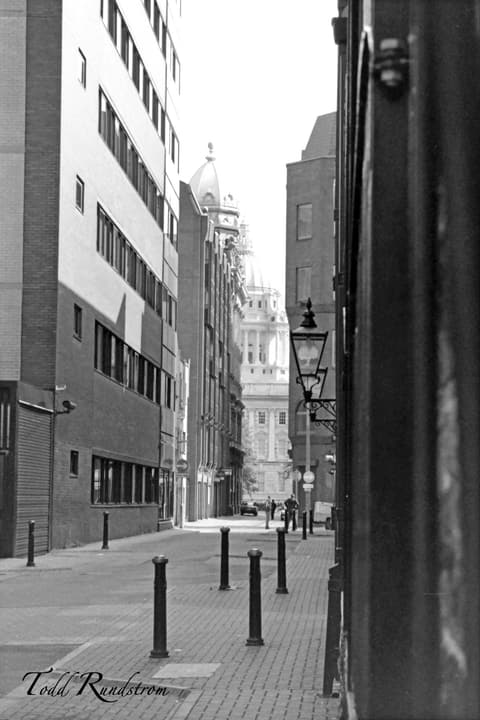
Looking Toward Belfast City Hall Get this as a printThis photograph was taken from a narrow side street in the heart of Belfast, looking toward the unmistakable green dome of Belfast City Hall.
Even from a distance, the grand Baroque Revival building dominated the skyline.
The contrast between the quiet, everyday street in the foreground and the imposing civic landmark beyond it caught my eye.
-

A Street Market Get this as a printI came across this lively street market while walking through the city. Vendors had set up tables right on the sidewalk with crates of fresh apples, bunches of flowers in buckets, and other produce for sale. People were stopping to browse, chat with the vendors, and do their daily shopping.
Behind the stalls, clothing shops advertised “Ladies & Gents” and “Childrens & Baby,” with racks of clothes spilling out onto the pavement. It was a colorful, busy scene — completely ordinary, and that’s what made it stand out to me.
-

Choosing Flowers Get this as a printI stopped and watched as this couple leaned over the buckets, gently touching and selecting flowers from the stall.
Bunches of fresh blooms stood lined up along the edge of the sidewalk — a bright, colorful contrast to the gray buildings and the serious atmosphere I had felt earlier in the day.
-

Fresh Vegetables at the Market Get this as a printThis close-up shows just how fresh everything was. Big, crisp heads of cauliflower were piled high, next to bundles of carrots still wearing their green tops, and a wooden crate overflowing with onions.
It was clear these had come straight from someone’s farm that morning. The quality and abundance felt honest and real.
-

Belfast and the Hills Beyond Get this as a printThis wide view shows the city of Belfast stretching out toward the hills that frame it. The most prominent rise in the distance is Cave Hill, a volcanic hill that has overlooked the city for thousands of years. On clear days you can sometimes see all the way to Scotland from up there.
In the foreground, a large parking area was packed with cars — a reminder that even in 1994, with all the tension in the air, people were still going about their daily lives, working, shopping, and moving through the city.
I remember standing here for a while, taking in the contrast between the busy, built-up streets and the ancient, quiet hills behind them. It felt like Belfast was caught between two worlds — one of history and division, and another of timeless natural beauty that had been here long before any of it.
-
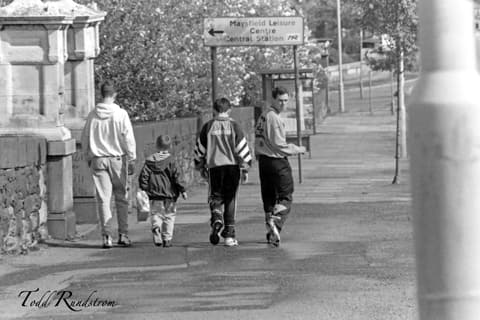
Heading Back to Central Station Get this as a printThis was the last photograph I took while walking around in the city before heading back to the train station.
I had been walking behind this group of four — three teenagers and a younger boy — who looked like they might be brothers or friends heading somewhere together. I was just about to take a picture of them walking away when the fellow on the right suddenly turned and looked straight back at me.
It was a quick, unplanned moment. I clicked the shutter.
After a day full of seeing soldiers and armored personnel carriers, this simple, ordinary scene of people just going about their lives felt like the right note to end on. I put my camera away and made my way to Central Station. It was time to leave Belfast behind.
-
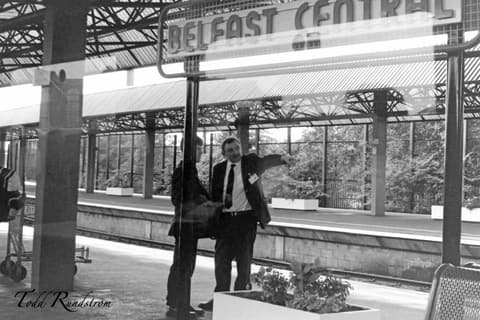
Asking for Help Get this as a printSafely back on the train and settled into my seat, I took a deep breath of relief and satisfaction. The day had been full — talking to soldiers on the street, getting free drinks from kind strangers at The Morning Star pub, wandering through the lively street market, and experiencing that strange mix of tension and everyday life.
As the train sat at the platform, I looked out the window and saw this scene: a traveler asking for directions, and a train station employee stopping to help. He pointed the man in the correct direction with a friendly gesture.
It felt like the perfect final image of the day.
Despite everything I had felt walking the streets of Belfast — the guarded atmosphere, the visible military presence — every single person I actually interacted with had been kind, helpful, and generous with their time. This small moment summed it all up. Belfast, for me, was a city full of good, decent people trying to live their lives.
-

Farewell Belfast Get this as a printAs the train departed Belfast Central Station and headed south to Dublin, I looked out through the chain-link fence and took one final picture of the city.
The old clock tower and long industrial buildings stood quietly in the distance, with the hills rising silently behind them.
1994From my journal
Day 4 / 9-10-94A Day in Belfast, Northern Ireland
The day is not actually over yet, but I have some time, and I don’t foresee anything too exciting happening later.
Today has run extremely smoothly for me. I woke up on time at 6:50, dressed, ate breakfast, and made it to the station for the 7:55 train to Belfast.
Everyone seems very upbeat about the IRA (Irish Republican Army) ceasefire of 10 days.
Belfast seemed very normal as I walked around until an armored personnel carrier drove by. It really scared me - I don't know why, but it did.
And then, as I turned the corner, I saw a soldier standing post with a nice big machine gun. I ended up going and talking to the soldier, who turned out to be very pleasant.
“It's still business as usual for us,” he said when I asked about the ceasefire.
I was eventually able to take his photo and that of another soldier a little farther away.
Here is what is weird though: in Dublin I felt uneasy because the police didn't carry any guns at all. I wanted to laugh at them. But in Belfast, I felt uneasy because I thought the authorities were too well armed. I mean, machine gun posts on street corners?
Something you don't see in America. But then again, I didn't see any headlines here proclaiming gang murders, kids killing kids, drive by shootings, etc. It leads to a lot of deep thinking.
Anyway, here's another episode of “Todd getting free stuff”. I was getting very thirsty, so I stopped in a pub called The Morning Star, which, it happened to turn out, was one of the original pubs in Belfast, dating back to the 1840s.
I started a conversation with a couple by asking if most people in Northern Ireland consider themselves British or Irish. British, they said.
They asked what I was drinking, and I replied water. Brian then jumped up to get me a drink. While he was gone, I explained to Mary, his wife, that the reason I was drinking water was because I didn't change any money to British pounds, since I was only going to be there five hours.
Brian then returned with my water - not regular tap water, but some expensive Perrier water. But Mary explained my situation, saying “Brian, he doesn't really want water, he just doesn't have any money.”
So Brian went and bought me a pint of beer. Then as if that wasn't enough, they gave me £3 so I could get something to eat or drink before I left.
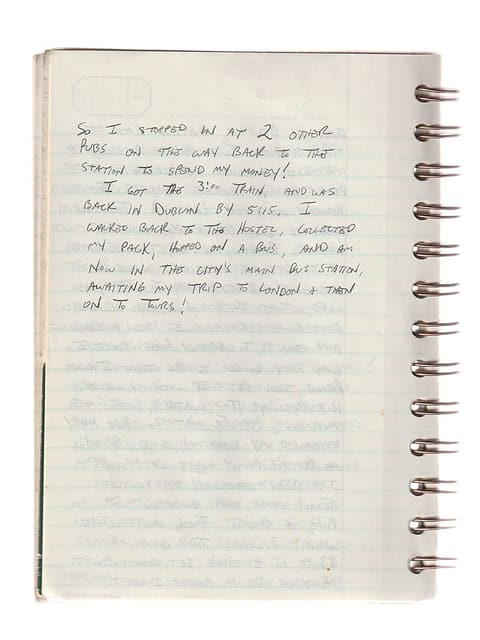
I stopped in at two other pubs on the way back to the station to spend my money!
I got the 3:00 train and was back in Dublin by 5:15. I walked back to the hostel, collected my pack, hopped on a bus, and am now in the city’s main bus station, awaiting my trip to London and then on to Tours!
JournalMy handwritten journal pages · 4 pages
-

-

-

-

My round trip train ticket from Dublin Connolly Station to Belfast Central Station.

My Map of Belfast
This is the actual map I carried with me the entire day I spent in Belfast on September 10, 1994. You can still clearly see the crease lines from where I folded it and kept it in my pocket. I pulled it out constantly that morning — checking street names, figuring out which direction to walk from the train station, and later finding my way back.
It’s one of those small, ordinary objects that became meaningful simply because it traveled with me through that day. Thirty-two years later, the fold marks are still there, just like the memories of walking these streets.
2026Looking Back
I was in Belfast on September 10, 1994 — just ten days after the IRA announced its historic ceasefire. At the time, no one knew if it would last. The city still felt raw and heavily militarized. Armored vehicles rolled through the streets. Soldiers stood on corners with machine guns. And yet, the people I met were kind. They bought me drinks in an old pub. They gave me money for food. They stopped to help a stranger asking for directions. Looking back, it was almost as if they were relieved to be showing me the grace they were longing for in their world.
I had no idea I was standing at the very beginning of the end of The Troubles.
The conflict had already lasted nearly thirty years and claimed over 3,500 lives. Just four years after my visit, in April 1998, the Good Friday Agreement was signed, creating a fragile but real path to peace. Four months later, the Real IRA carried out the Omagh bombing, killing 29 people. It was the last major terrorist attack of that era.
Since Omagh, Northern Ireland has not experienced anything close to the sustained violence that defined The Troubles. The daily reality of bombings, shootings, and military checkpoints has largely disappeared. Today, Belfast is a vibrant, confident city. Thousands of tourists now pay to take Black Taxi tours to the Peace Walls — the very barriers that once divided communities. What was once a desperate security measure has become one of the city’s biggest attractions.
U2 still sings “Sunday Bloody Sunday” in concert. They should. Some things must never be forgotten. However, on their 2000 album All That You Can’t Leave Behind, U2 has a quiet track called “Grace.” One verse has stayed with me for years:
What once was hurt
what once was friction
What left a mark
no longer stings
Because Grace makes beauty
out of ugly things.
That line feels like it was written for The Troubles. And if I’m honest, it feels like it was written for me too.
I’m grateful I was there when I was. I’m grateful I made the deliberate choice to get off the train and spend those five hours in Belfast instead of staying safely in Dublin. I walked the streets with my camera, talked to soldiers, accepted kindness from strangers, and documented a city caught between its violent past and an uncertain future.
I left with photographs, journal entries, and a deep sense that I had witnessed something rare — the first fragile signs of peace taking root in real time.
I’m truly glad they found peace.
And, thank God, I am equally glad that I have found peace in the years since too.