Date
Versailles
CountryFrance
- Reading
- 9 min
- Words
- 2,124
- Images
- 16
Part 1: The Palace of Versailles
After a week of good food, late nights, and easy living with Olivier in Tours, another opportunity dropped right into my lap — too good to pass up.
Olivier’s older brother and sister-in-law lived in Paris and had offered me their apartment for the weekend while they were traveling.I arrived Wednesday evening, September 28, after a 90-minute ride from Tours on the TGV — France’s high-speed train — and settled into their place.
The speed of the train blew my mind!
We were flying through the French countryside at nearly 190 mph. Looking out the window, everything was just a blur. It felt smooth, powerful, and like something out of the future.
I had the entire next day — Thursday, September 29 — to explore Paris on my own. Unlike most days up to this point, I actually had a loose plan, with some places I definitely wanted to see. My first stop was the Palace of Versailles, home of King Louis XIV.
I took a combination of the metro, a couple of buses, and walked the rest of the way. Unlike Buckingham Palace in London, which left me unimpressed, Versailles completely overwhelmed me. The palace was enormous, opulent, and extravagant — a far cry from The Dome, the college party house I had been living in back in Kearney.
Walking through the Hall of Mirrors, seeing paintings bigger than any I had ever imagined, and looking out over gardens and fountains that seemed to stretch to the horizon… it all made me feel incredibly small. It was one of the first places on this trip that really drove home how different European history felt compared to what I had grown up with back home in Nebraska.
I spent a few hours wandering the building and grounds, taking photographs, and trying to absorb it all. Even though I was on a tight budget and still traveling alone, I was loving every minute of it.
One thing was still weighing on me, though — I still hadn’t found my missing journal. I remember thinking about it on the train ride into Paris, wondering ‘where in the world is it?!?’
Because of that, I’m writing these memories from memory now in 2026.

Nymph of Summer
This reclining statue is one of many classical nymphs that decorate the gardens of the Palace of Versailles. These figures were part of a massive sculptural program commissioned by Louis XIV in the 1670s and 1680s. Most of the reclining female statues represent nymphs associated with nature, fertility, or the seasons. The fruit and flowers surrounding her suggest that this particular figure symbolizes Summer or Abundance.
The majority of these statues were installed between 1675 and 1685. They were designed to glorify the grandeur of Versailles and to reinforce the image of Louis XIV as the “Sun King,” bringing order and beauty to the natural world.
My Photographs from Today in Paris
My first stop was the Palace of Versailles, home to King Louis XIV.
-
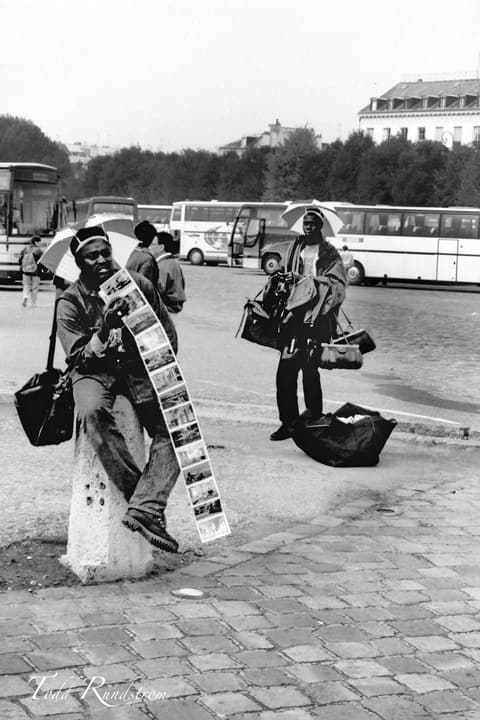
Postcard Hustle Get this as a printTwo men worked the tourist crowds near a major Paris landmark, trying to make a living by selling postcards and souvenirs. One sat on a concrete post, holding up a long strip of images, while the other stood nearby with bags of merchandise and an umbrella.
This was a common sight in Paris in the 1990s — street vendors moving quickly between tour groups and buses, doing whatever they could to make a sale. I found these moments just as interesting as the grand monuments. They showed a different, more real side of the city that many tourists never really saw or acknowledged.
-

Working the Buses Get this as a printThe two men had set up near a line of tour buses, ready to approach visitors as soon as they stepped off. One stayed seated on the post, displaying his postcards, while the other stood with several bags at his feet, keeping an eye on the arriving groups.
-

Another street vendor Get this as a printThis man positioned himself right in the middle of the grand gateway leading into the Palace of Versailles grounds. With his long strip of postcards held up, he made himself impossible to miss as visitors walked past.
I found it interesting how comfortable these vendors seemed here — confidently working one of the most iconic entrances in the country and making themselves part of the constant flow of visitors.
-

Seeing the Palace Get this as a printI walked out into the massive cobblestone courtyard in front of the Palace of Versailles and stopped to take it all in. In the center of the square stands an equestrian statue of King Louis XIV, the man who transformed Versailles from a modest hunting lodge into the greatest palace in Europe.
Louis XIV, known as the Sun King, moved the entire royal court to Versailles in 1682. He did this deliberately — to remove the nobility from Paris and keep them under his direct control. The palace became both his home and a stage where he performed his absolute power every single day. Everything about Versailles — the architecture, the gardens, the art, and even the daily rituals — was designed to glorify him and reinforce the idea that he was the center of the universe.
-

The Royal Chapel Get this as a printThis is the Royal Chapel (Chapelle Royale) inside the Palace of Versailles. It was the last major construction project completed during the reign of Louis XIV, finished in 1710 — just five years before his death.
As a devout Catholic, Louis attended Mass here every single morning. The chapel was designed in a two-level format. The ground floor was used by members of the court, while the royal family worshipped from the upper tribune (balcony level). The large pipe organ at the back was used for both religious services and royal ceremonies.
The dramatic ceiling fresco depicts religious scenes, and the entire space was meant to reflect the divine right of kings — connecting Louis XIV’s power directly to God. Even though Versailles was famous for its extravagance and parties, the king still maintained a strict daily religious routine in this very room.
I stood in the doorway for a long time, just taking in the scale and the quiet power of this sacred space.
-
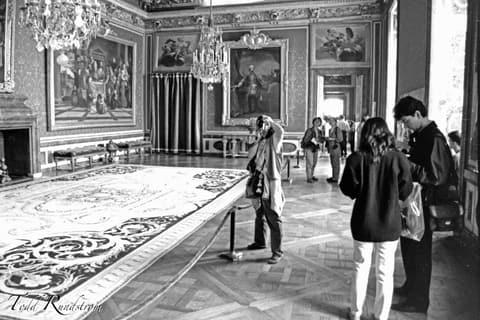
The Throne Room Get this as a printThis is the Salon d’Apollon, the official throne room of Louis XIV. The king’s throne once stood at the far end of this room, beneath the large central painting. This is where he received foreign ambassadors and conducted formal state business.
The room is dedicated to Apollo, the Greek god of the sun — Louis XIV’s personal emblem. Everything in the decoration was meant to glorify the king and present him as a powerful, almost divine ruler. While Versailles is famous for its lavish parties, this room shows the serious, ceremonial side of his reign.
-

The Hall of Mirrors Get this as a printThis is the famous Hall of Mirrors, the most celebrated room in the entire Palace of Versailles.
Completed in 1684, the hall was built to impress and intimidate. One side is lined with 17 large mirrors, while the opposite side has matching windows overlooking the gardens. The effect makes the space feel even larger and more spectacular. Louis XIV used this room for major state ceremonies, receptions for foreign ambassadors, and important royal events. It was meant to showcase the wealth, power, and artistic superiority of France.
The Treaty of Versailles was signed here in 1919, formally establishing peace between Germany and the Allied powers after World War I.
-
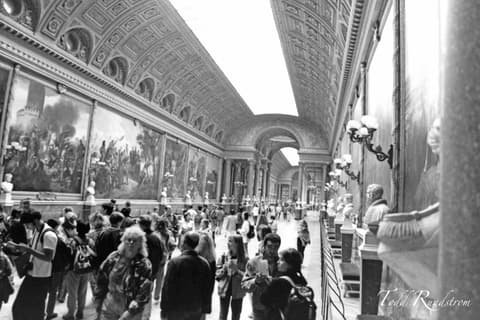
Galerie des Batailles Get this as a printThis is the Galerie des Batailles, a long gallery in the south wing of the Palace of Versailles dedicated to French military history. It was created in the 1830s by King Louis-Philippe as part of his effort to turn Versailles into a museum celebrating the glory of France.
The walls are lined with massive paintings depicting key battles from French history, and the busts along the right side represent famous French military leaders. Unlike the more intimate and decorative rooms of Louis XIV’s era, this gallery was designed to feel grand, serious, and patriotic.
Walking through it gave me a strong sense of how much French identity has been tied to military achievement over the centuries.
-
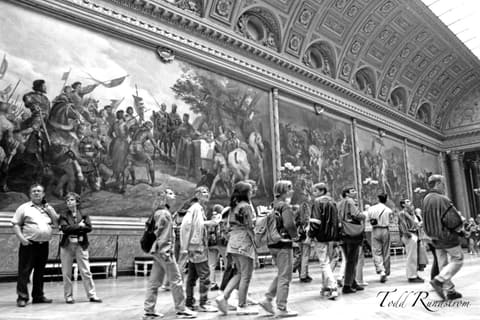
The Scale of History Get this as a printThis view of the Galerie des Batailles shows just how enormous these paintings are. Each canvas stretches across the wall, towering over the visitors standing in front of them. The room was designed to feel grand and imposing, with these massive battle scenes meant to celebrate France’s military past and inspire a sense of national pride.
-

Walking Through History Get this as a printThis long view of the Galerie des Batailles shows the impressive scale of the room. Stretching the entire length of the south wing, it’s lined with massive paintings depicting key moments in French military history, from the early Middle Ages all the way to the Napoleonic era.
Tourists walking through it today are surrounded by larger-than-life battle scenes and busts of famous generals and leaders. It’s one of the most dramatic and imposing spaces in the entire palace.
-
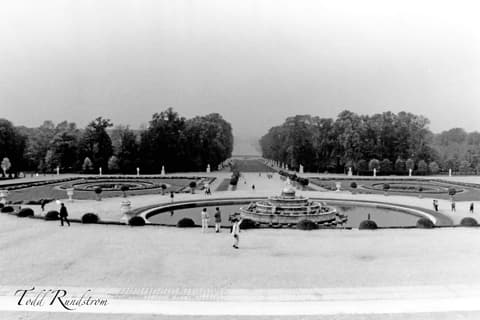
The Gardens of Versailles Get this as a printThis is the view looking out from the back of the Palace into the formal gardens. These gardens were just as important to Louis XIV as the palace itself. He used them for grand outdoor spectacles, parties, and to demonstrate his absolute control over nature.
The central walkway leads all the way to the Grand Canal, which stretches over a mile into the distance. On either side are perfectly manicured groves, fountains, and statues. Even on this overcast day, the scale of the gardens was impressive.
I spent quite a while walking these paths, constantly turning around to look back at the palace rising behind me. At one point I thought to myself, “All that’s missing is a sand volleyball court.”
-

The Long Perspective Get this as a printThis view from the central walkway really shows the incredible scale of the gardens. Designed by André Le Nôtre, these formal gardens were laid out to create dramatic perspectives that draw the eye toward the palace. The wide grass path stretches for hundreds of yards, lined with perfectly trimmed trees and classical statues.
Walking back toward the palace, I was struck by how deliberately everything was designed to make the king and his home the absolute center of attention. Louis XIV wanted visitors to feel the power of Versailles long before they even reached the building.
-
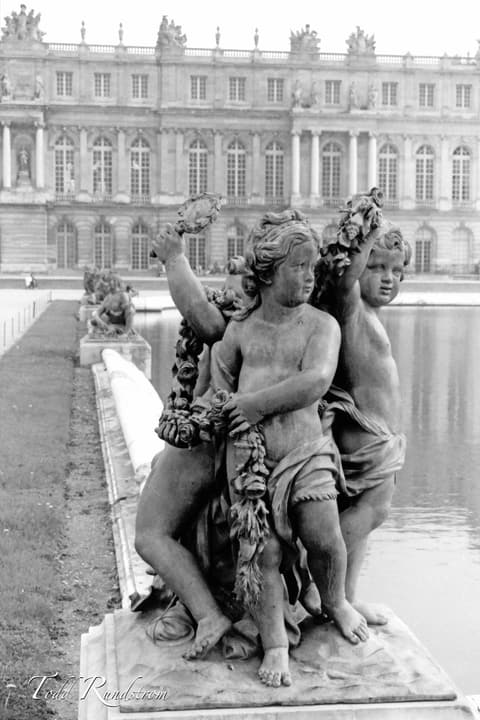
Garlands of Versailles Get this as a printThese classical statues stand along the edge of one of the large water basins in the gardens. Covered in garlands of flowers and fruit, they represent the themes of abundance and celebration that Louis XIV wanted to project throughout Versailles.
I found these smaller, more playful sculptures charming after walking through the grand, formal spaces inside the palace. They felt more lighthearted — a nice contrast to the overwhelming scale and seriousness of the architecture behind them.
-
Nymph by the Water Get this as a printThis reclining statue is one of many classical figures placed throughout the gardens of Versailles. Created in the late 1600s during Louis XIV’s reign, she represents abundance and the richness of nature, resting beside one of the large water basins with the palace rising in the background.
-

Louis XIV on Horseback Get this as a printThis is the famous equestrian statue of Louis XIV, standing in the Place d’Armes directly in front of the Palace of Versailles.
The statue shows the king as a powerful, commanding figure — very much the image he wanted to project. I found it amusing how casually people treated the monument, sitting on the base, eating, and resting their feet. Louis XIV probably didn’t envision his statue being used as a park bench.
2026Looking Back from 2026
After a full week of slowing down in Tours with Olivier — eating well, staying up late, and living like a local — I suddenly found myself on a high-speed train into Paris. The contrast was sharp. One minute I was relaxed and comfortable, and the next I was flying through the French countryside at nearly 190 mph, heading into one of the most famous cities in the world with a free apartment waiting for me.
Versailles left a real impression on me. Walking through the Hall of Mirrors and out into those enormous gardens made me feel small in a way I hadn’t experienced before. It was so far removed from the life I had been living back in Kearney — the parties at The Dome, the casual chaos of college — that it almost felt like visiting another planet. I remember thinking how different European history felt compared to what I had grown up with.
The next spot I wanted to visit during my day in Paris was a cultural shrine to many people in my generation… Jim Morrison’s grave in the Père Lachaise Cemetery.